Showing posts with label Writing Advice. Show all posts

22 January, 2017

Meaningless Meaningful Methods and Fruitful Formulas... and arbitrary alliterations...


Most writers can boil down their method into a few words.  These words will mean almost nothing to anyone else, but can be interesting to hear.  They've certainly be useful to me.

Neil Gaiman:  "Make good art."  (https://www.youtube.com/watch?v=ikAb-NYkseI)

Paul McAuley:  "The reader follows the character, not the story."

Scott Bradfield:  "It's all about point of view and narrative time."

Elmore Leonard:  "F**k you!  I'm working!  I wrote a book with 10 of these epithets already!"

If you haven't read it, get it:


(Do note that this book is extremely short and simple, and it's entire contents, roughly 1,000 words, can be found on the internet.  Personally I enjoy having a hard copy and found my investment, some 7 years ago, valuable.  If I'd just read it online, it wouldn't be there calling to me and I wouldn't be reminded of its importance every time I look over my bookshelves.)

Anyway, most of us have a stupid epithet because it helps us.  Einstein said if you can't explain something in simple terms, you don't understand it.  What that means in this context is, explaining something in simple terms helps you understand it.

And I think I've discovered my formula, so:

Wm. Luke Everest:  Something you care about, written in a simplistic way.

Let's break it down.

Something you care about doesn't have to be about politics, or culture.  It can be that you care about your fantasy world.  Or, as is usually the case when I write, it's caring about a character and that character's journey.  Either way, before you sit at the keyboard, ask yourself why you care.  When you type, do care.  The objective here is to make the reader care, too.

Writing in a simplistic way doesn't mean it looks simple, or even that it would be simple for someone else.  What it means is, it's a story you have a handle on, and it all seems simple to you.  This doesn't even have to be from the start.  Maybe you're really pushing your boundaries.  Great.  But by the end of it, if you can't look at your story and go, "It's definitely all about this stuff here, and it all works because of this," trust me, the book needs work.  Why and how it works should be very obvious to you, the creator, by the end.  If it doesn't work for you, it won't work for anyone else.

There will of course be exceptions to everything, and I do not claim the above to be all inclusive for everyone.  The whole point is, it's inclusive for me.

So there it is.  My little method might not help anyone.  It almost certainly won't be your phrase.  But I've always found reading other writers' methods interesting and useful.

My pointless picture for pinterest is of a kitten at a keyboard.  I thought about a monkey at a typewriter, because that's what I feel like sometimes, but then I thought, kittens are cuter, so why not?  This is the sort of thing I frequently wake up to, anyway.  The joys and tribulations of living with a cat.

Image result for kitten at keyboard

05 January, 2016

Ring in the New Year

The long blog hiatus was this time for a very good reason, and I stand by it.

I recently had the biggest punch in the stomach of my career. I finished Forget Me Not, was told it was very good, but that it wasn't marketable in the slightest. Tragedies don't sell, according to many so-called "experts". I say those "experts" are incredibly out of touch with young people today. I say Emo and Goth music wouldn't exist if young people weren't capable of appreciating deep feelings, or indeed enjoying art designed to explore melancholy. Those particular styles in that particular art are just two of a myriad examples. In fact, as a person who wants to write for young people, I find the idea that they're incapable of appreciating tragedy quite offensive.

But I'm not delusional. It's true that tragedies are, on the whole, one of the least lucrative (if not the very least) kinds of stories. I believe Forget Me Not will be one for the future, for the critics. These days, publishers aren't interested in anything by a new author unless they think it's a guaranteed hit. That's why there's so much shallow trash out there in the YA market. There's some great stuff too, but something's wrong when the really great writers have a tougher time getting started than the ones who want to crank out some generic "Heroic young person takes on evil grown-ups and wins" story. I don't want to write that crap.  I always hated reading that crap, too.

After getting my feedback about Forget Me Not, I felt lost. I'd spent so much time believing that good books will out, that craft is the most important thing, that ideas are cheap and it's all about execution, and that gripping and beautiful stories would, if they're well told enough, get published. It turns out I'm working in an industry that never would have published Catcher in the Rye, for instance. How would you pitch that one to an agent? What's the synopsis? "Jaded teenager wanders around New York for a weekend." Doesn't sound like a rain-maker to me, and yet every agent who would scoff at that synopsis (i.e. all of them) would be dead wrong. Even if Catcher in the Rye isn't your thing, I can think of dozens of mega-best-sellers with an equally boring synopsis.

I was lost, and down, and had to pick myself up again, and I didn't know how. I was very close to giving up on the whole thing. If it's not about good fiction, what's it about? What's the point?

That's how I felt, and I didn't want my bitterness to spill over into my blog. I couldn't write anything without seeming bitter, because I was bitter, but I think, actually, this has been my greatest lesson, and I hope it's my final hurdle.

Every NEW writer I've ever known has pinned all their hopes and dreams on every work they've produced. This is difficult, because most of their early work isn't very good, any more than a pianist's first attempts at playing a tune. It's practise. It was difficult anew when I wrote something that I KNEW was good. Industry experts TOLD me it was good. I was RIGHT, and yet I still hadn't achieved a thing.

Now, I just don't care anymore. I'm broken. It's only after we've lost everything that we're free to do anything, as Tyler Durden said. And it's when we're broken that we can most easily forge ourselves anew.

Now I just feel like I'm writing books. I'm pretty prolific. I'm making plenty of money in my day job (or, enough to survive, anyway) and I'll write one my agent thinks could be a rainmaker eventually. I'm focusing on "cool factor" as much as depth or meaning. I think it's entirely possible to achieve both, and I'll admit Forget Me Not was light on "coolness" as one of the emotional effects. It was a tragedy through and through. I have a handy writer's group that I started in Leamington Spa where I live. Every time I show them my work I ask whether they felt what was happening was cool. I'm going to write something with cool factor eventually, and I refuse to give up on my ambition of creating work of social, moral and emotional significance. I strongly believe one can achieve both, and I'd be far from the first to do so. I'm still at it, about 8,000 words into another book, fully plotted, and now that I've taken my hard-earned Christmas break, I'm still writing every day.

Every knock-back I receive, I learn a little more the importance of what Karen Blixen said: "Write a little every day, without hope, without despair."

I won't forget Forget Me Not, but I'll learn, and I'll grow. There's no such thing as failure. There's just trying and giving up.

30 March, 2015

A Fantastic Opportunity

Readers who are writers! Below is an email sent to me by Scott Bradfield, my extensively awesome writing mentor. Long-time readers will know his name. I have sung his praises many times. He is a famously awesome craftsman--LITERALLY as famously awesome as it's possible to get without being dead long enough to have your work revered by English Literature professors!

There is honestly no better opportunity for help with your writing than to solicit his help. He is a phenomenal craftsman, and a superb and experienced teacher. He taught me everything I know, and the more I learn, the more I discover the many messages deeper within his advice. His advice has provided me signposts along this road, such that when a new enigma has presented itself, or a new answer just out of reach, a memory will sing in my ear and the answers will come. That's all thanks to Scott. I've paid for the Writer's Bureau Home Study Course. I've read everything on the Writers of the Future pages. I've viewed countless blogs and watched video lectures by writers both obscure and famous and I've paid thousands of pounds (like dollars only worth more) for university degrees and honestly, NOTHING has compared with what this guy has taught me. I would trade all of it (except the degrees) for another hour of his time, and here he's offering you several hours for, considering you'll get as much out of it as you would any university course, next to nothing.

I'm not just selling him here arbitrarily. I am willing to stake my entire reputation on this, and I say that with no hesitation. If you're struggling to get your craft up to the next level, Scott has answers for you. Open your mind and your ears, and Scott can change your life. He certainly changed mine.

Rather than fool about with my own advertisement, I've decided simply to re-post his Facebook message. Even if you're not interested yourself, I'd consider it a personal favour if you'd re-blog this, and any reader of yours who signs up will, I promise you, thank you for it.

Scott's message begins:

Last year, I established some online CW courses at City Lit, and have experienced endless problems making them available through City Lit catalogs, or on the City Lit website - regions of information that are fraught with peril. The three current City Lit courses can be found at the following links - and they all start up for term three on 20 April 2015:

http://www.citylit.ac.uk/…/novel-writing%3A-an-online…/hw362

http://www.citylit.ac.uk/…/short-story-writing%3A-an-online…

http://www.citylit.ac.uk/…/advanced-writing%3A-an-online-co…

If you know anyone who might be interested in these courses - or in our independent experiment in online creative READING (and writing) - the Ultimate Beginners - could you please pass this info on to them?

Here's my recent letter to current and past students in my online courses, summarising the programme, and its perils:

Two years ago I started these online courses at City Lit for several reasons, but mainly to provide students the sort of one-on-one manuscript comments that we can't provide in-class, AND to make it possible for self-motivated students to work to their own schedules. City Lit provides REALLY affordable prices - AND concessions/senior rates - that most schools can't provide. And, I can promise you, EVERY other online writing course costs three or four times what City Lit charges. And all of those other online courses (from what I can see) are not very good.

On the other hand, City Lit has been going through lots of changes/difficulties in the past couple years, and they have done a terrible job publicising these courses. They often leave them off the catalog/online catalog altogether; OR they make it difficult for students to enroll; OR, as I just learned this week, they actually ERASE all the descriptive material from the catalog, so that what the course is, and how it works, is extremely confusing. OR they post misleading information.

For the past few months, for example, the catalog made it seem that students would have to "attend" THREE one hour sessions each week, and at specific times. They also managed to ERASE all the positive reviews these courses have been receiving from students! AND they ERASED all of my descriptive material for ALL of the courses! Jeez. And I only found out about these problems by accident - when a prospective student wrote me trying to understand what was going on.

I'm sort of exhausted trying to keep ahead of all these problems, and am asking all my students this term to do me a favour: if you have found the course useful and/or a bargain (and I will STRONGLY contend that it's a "bargain"), please let your friends and family know about the courses, or promote them where you can - Facebook pages, writer groups, whatever. OR provide reviews on the City Lit website that help students understand how the courses ACTUALLY work. And be prepared to have those reviews ERASED!

I just can't keep up with these problems anymore - and feel that City Lit's marketing department is unable to make these courses available - or understandable - to potential students. The courses will definitely die if we leave things to City Lit. Sorry for that long-winded "favour"! And I promise not to ask again or pester you about it. But if you would like to see courses like this carry forward at roughly these current prices, do please help get the word out!

We now return you to the regularly scheduled broadcast!

P.S. I google image-searched "angry writer" to illustrate this post - and here's what I got below!

10 March, 2015

Theme Fiction

Recently, I had an almost-polite altercation with a friend about whether Interstellar is a good movie. His issue was basically that the theme was confusing, which made the movie listless. As many budding authors read this blog, it drew to mind a distinction that one should know:

THEME AND TOPIC ARE NOT THE SAME THING.

There.  I said it.

My friend cited Alien as a movie with a simple, comprehensible theme: the theme of rape. It's hard to explain to people who aren't interested in making art, but Alien does not have a theme. A theme is an INTENDED EFFECT. An intellectual effect, mostly, but the attachment of that effect is achieved through emotional connections much as anything else in fiction. Theme is most certainly not something for people to write dissertations about twenty years after the film is made. It's an INTENDED EFFECT for the viewer/reader to walk away with upon completing the movie/book, much like everything else in good fiction.

Alien doesn't have a theme. It's a very simplistic horror movie. It's intended effect is to be afraid of scary monsters. It's excellent. It's a tight, gut wrenching narrative about death and fear and escape and, indeed, powerlessness in the face of a frightening monster. In fact, to say it's about rape simply because the main character is a woman has to be one of the most inadvertently sexist comments I've ever heard.

Even more importantly, rape can't be a theme. Why? Is it an INTENDED INTELLECTUAL EFFECT? Hell no. It's not an idea. It's an action. It's like saying, "The theme of American Sniper is shooting guns." Bullshit. The theme can be to make us think about how shooting guns, or rape, is wrong, but Alien made no such attempt. It made us think about how much it would suck to get chased by scary monsters.

Now, as someone who's taught women's self defense, I feel icky even writing that word, so I'll have to drop that subject now and move on.

The bottom line is, even if Alien were about that (which it isn't, just to be clear) there's a difference between what a movie's about and its theme. American Sniper is about shooting people. Is that a theme? No. Selma is about civil rights movements and racism. Is that a theme? No. "Racism is wrong" can be a theme, but racism itself is a topic, as are civil rights movements.

Let's give an example of something with a great theme: To Kill a Mockingbird by Harper Lee. Never judge a person before walking a mile in their shoes. That theme is reiterated over and over. In just about everything that happens in the book, even in most conversations within the book, we are given the idea of how judging a person is wrong. We are reminded of how people are intricate creatures who cannot be understood simply by staring at them from the outside. And once you understand someone, you'll never want to judge them.

A theme can make you reflect on other things. For instance, To Kill a Mockingbird has the potential to make someone reflect on racism. But is the theme "racism"? That's not a theme. Can it make us think about how racism is wrong? Yes, for the same reason you shouldn't judge a person without walking a mile in their shoes: all people are inherently equal.

People can walk away with different reflections based upon how the theme resonates with their own experiences. In America, readers tend to hone in on the idea of race, because of the racial issues that still persist in your country. No offense, but the rest of the 1st world isn't like that, and if you don't believe me, you've never lived in Canada.

The trial only takes up 1/3 of the book. To Kill a Mockingbird does not mention race on every page. But every page does ooze the idea that you shouldn't judge a person without walking a mile in their shoes. The movie, which did not feature that guy from the Superbowl commercial, focused on the trial because it's a big dramatic hinge-point. It's a thematic hinge-point too, and inherently so, because a well integrated theme will be in every way tied to the drama.

Reflection on the theme is an INTENDED INTELLECTUAL EFFECT. That's why everything in the book is so exquisitely tailored to it. Without that understanding, an artist can never create themes of their own, because they must understand that it's not a question of the topic you want to cover. It's a question of the thoughts and reflections you want your reader to walk away with.

My picture for Pinterest this time is chosen to illustrate why people grow up with misconceptions about themes. Namely, we're taught wrong. This picture is a sheet for school. (I teach English on the side.) It's basically forcing students to fail to understand what Harper Lee did, and fail to understand how fiction is made, and indeed, fail to attain good grades based upon your own honest reading experiences. School is, in essence, judging you intellectually without attempting to walk a mile in your shoes.


Note the word "themes", plural. Bullshit. Note also the focus on racial issues. Reflection as a result of the theme. Not the theme itself. (Intended reflections perhaps, but that changes nothing.) Note how, if you have any real insight into the truth of a subject, school will make every attempt to beat that out of you. Just a personal grudge, there, but you'll see that topic in my books frequently.

To far too many young people, their relationship with society looks too much like this:

18 January, 2015

Another Lesson from Stephen King

One issue I had with my book was that readers were enjoying it in a highbrow, literary sort of way. They enjoyed delving into the ambiguities and wondering what was going on behind the surface. That's all well and good, so long as readers are interested, but it isn't really what I'd intended. The especially egregious ambiguity was as to whether my main character has telekinetic abilities, or if it's all in his imagination. For a couple of days, I couldn't understand how anyone got that idea. Then I read Carrie by Stephen King, a master of my weakness, plotting.

The first paragraph is about how much of a time bomb a telekinetic person can be. The second paragraph goes, "Of course what none of them knew was that Carrie White was telekinetic."

I laughed my ass off. My main character had been unsure of his gifts at the start of my book, and that meant my readers were unsure, too. Some readers were having trouble figuring it out.

But it doesn't mean characters can't be unsure. It means the author must find a way to make the reader sure. The deeper point is, the premise, and the hint of the dramatic, should be on the table right away. I don't want to write for highbrow people. I want to write for everyone. I'd love highbrow readers to enjoy my work, but I don't see the point of writing work designed to make self-congratulating, Oxford-cloth twits think I'm clever. The point of art is to impact upon people, as such, the amount of people it reaches is vital. Art happens every time someone listens to music, or reads a book, or plays a poignant video game. Art isn't simply in the artist. It's a gift from the artist, and a gift is just a colourful box until it's unwrapped.

Now, as it's necessary to post on Pinterest, I'll honour him with a picture.


As always, thanks dude.


30 October, 2014

Description and the Learning Curve


First off, what's the "learning curve"? I've nicked this phrase from Brandon Sanderson, so I'll tell you what it is to him. It's your readers learning about your world. It is highly prevalent in speculative genres for pretty obvious reasons. We're entering a new world.

The learning curve can equally refer to the process of your reader really knowing what's going on in the plot. That's a highly related issue, so I'll touch on it.

I was watching one of Brandon Sanderson's many awesome lectures on Write About Dragons, when he asked the class why we should write with short, sharp description. Credit to the class: they touched on it. All the same, I wanted to scream through the computer screen at them, which I why I'm screaming at them through a blog post now.

We do it because the reader wants the story. Simple as that. They want to know what the smeg is going on. "Matt jumped over the wall." That tells us what Matt's doing. We' know there's a wall there, we know he's jumped over it, and we know, by strong implication, next time we see him he'll be on the other side of it. Great. The rest is shading.

Shading is great. So long as you don't consistently resort to adverbs and adjectives. "Matt swiftly bounded over the abundantly tall wall of stone that was built in 1946 when German settlers came to Townsville on boats made of oak trees, which were a common tree in Germany back then, hence being used to create the many boats that the settlers, one of whom was Matt's great great great great grandfather, used in coming over the Atlantic ocean, which is the world's second largest ocean and" AAAAAAAAAAAAAAAAHHHHHHHHHCKKKKKKKKK!!

That's the ultimate way of doing it badly. We've got pointless adjectives, we've got useless information, we've got more useless information that stacked upon the first stuff.

So what do I mean by shading, and how can one do it well? The biggest problem above is that I told you all about the wall. It didn't have anything to do with the story. "Matt shifted his weight to the crutch, swung his bad leg onto the wall's edge, and cried out as the bullet wound stung afresh." That's not amazing. It's off the top of my head. But you get the point. The fact that Matt's using crutches, and that he's got a duff leg because he's just been shot, has to do with the story. I shaded his act of jumping in ways the reader might find interesting.

So again, what's the point? The reader wants to follow your character through your story. They don't want you leading them off somewhere pointless.

How's that relate to the learning curve?

That's the other thing Brandon Sanderson was talking about, and he mentioned how people so often in Mid-grade fiction begin in our own world. Why is that? Why does that solve the problem of the learning curve? (The problem being that, given that the reader must understand a new place with new rules, it's very easy to muddle the story.  It's also a wonderful thing.  It just raises certain issues that must be addressed.) The class touched on it, again to their credit, pointing to the way you get to enter it gently and so forth. They missed the point, though, which ties to how we want to follow the character through the story.

In those books, the learning curve is an inherently vital element of the character's journey through the story. Frequently (Peter Pan, Narnia, Alice Through the Looking Glass and many others) the learning curve, an a legitimate sense, IS the story. We have instant fascination with the things we're going to learn for the exact same reason that readers don't want meandering description: readers want to follow a character through a story. That's why we read.

06 October, 2014

Write Where it Hurts, or Feels Good. Whatever.

Most writers say to write what you love to read.  I say that's very very true, and especially important to new writers, but by going a layer deeper we can understand something about the creative self.

Write what you feel most passionate about. The type of books that have stayed with you the longest, that have really shaped who you are as a person, that have given you dreams and nightmares--those are things worth writing about.

For me, I love reading fantasy fiction, and elements of fantasy will certainly be present in almost all my work. I like science fiction, but usually only love it when it starts to border on fantasy (when it doesn't work to adhere to stringent scientific rules or plausibility). No one can read my stories without seeing my love for fantasy.

The stories I have enjoyed most in my life have been Robert E. Howard's Conan stories. These are grossly underestimated. Bob Howard was a brilliant man, and his intelligence shines through in these stories in his passion for ancient times, the folly of civilization, and the evil of religion. Whether or not you agree with his anti-theist themes, they are ever-present and powerful.

I've probably read A Spell for Chameleon by Piers Anthony twelve times. That's the first book that got me into reading.

But what's the first book that changed my life? A Catcher in the Rye. I read it very young, and it made the whole world make sense. Holden Caulfield made me feel like I wasn't alone, and that other people too saw the way society changes people too easily, how shallowness is lofted as a virtue, and how too many people choose not to notice the problems of the world around them. I am certain that if Holden had been at my school, we would have been friends, and would have listened to Nirvana together. He would have been just as big a fan as I. Things like Nirvana, and A Catcher in the Rye, proved to me that art could really change people, and criticize the world in intelligent ways. That's what made me want to be an artist.

The books that have impacted upon me the most are the aforementioned, 1984, All Quiet on the Western Front, Lord of the Flies, Heart of Darkness, Fight Club, Fahrenheit 451, Brave New World, To Kill a Mockingbird, Of Mice and Men, a small selection of Conan stories, and A Clockwork Orange. It's a short list. Those aren't the only books I love (indeed, my favourite genre only crops up once) but they're the ones I truly wish I'd written. And what could inspire my work more than that?

I was also very inspired by two poems in particular: Always Comes Evening by Robert E. Howard, and The Phoenix and the Turtle by William Shakespeare.

If you're a writer, you'll probably have a list like this. It doesn't matter what's on the list, and if it is populated by the genre you enjoy reading the most, then that's great. If anything, you'll probably have an easier time finding story ideas. Nothing wrong with that. All I'm suggesting here is a different way of deciding what you should write about. It's not what you love, it's a question of who you are, and the answer to that rests with what has impacted upon you the most. The goal of narrative, after all, is to impact upon others.

Now, one needs pictures to stick things on Pinterest, so this one represents something that to me both hurts and feels good. There's beauty to me in the idea of nature growing over the remnants of high civilization, but there's also sadness and horror in it. So this one's for Pinterest, and I guess for me:


(I must note that I in no way believe this sort of writing, this desire to change things, is any better than writing for enjoyment. It is merely a question of knowing who you are and being honest with yourself. If what you love are fun stories, for instance, if that's what made you want to be a writer, you'll probably be really good at writing fun stories, and the world needs fun stories just as much as it needs sombre, gritty things. What I love are dark, gritty stories. That's the only reason I want to write them. It is not because I think my goals are any more important or worthwhile. I have to say this because too many authors use words like "serious fiction", and draw a distinction between "literary" and "popular". Such distinctions disgust me, and I have to make it perfectly clear that I am not one of these pretentious douche-bags.)

11 July, 2014

Mega-death by Considerably Fewer than a Thousand Cuts


No, not Megadeth, the band with the most on-the-nose name in the history of Heavy Metal.  I'm talking about taking a character in a novel, and killing her.

No, not in the story.  Not that she gets killed.  I mean, actually eradicating her from existence, as though I were a god and she were a creature of my creation, and I control her destiny and all that stuff.

A week ago I got another email from my agent.  It turned out she thought the novel would work better without a certain character--a major character.  She gave the advice so casually.  It was off the top of her head.  And at first I felt like screaming.  Writing a new beginning was a pain in the ass, not because of the beginning itself, but because I had to go through the entire damn book afterwards with a fine-toothed comb, making sure I referred back to the beginning wherever dramatic, and making sure everything made sense.  That took forever.

Imagine how long it would take to get rid of a vital character.  It would take forever, right?

The thing is, Leslie (agent) was right.  It wasn't a vital character.  I was amazed and appalled that it took me all of two days to get rid of her.  I worked solidly for about 14 hours per day, but still.  Most of it was easy.

All the same, I still can't believe just how long this process is.  I like having an agent who's a perfectionist, but I had imagined you get an agent, she contacts publishers, you sell your work (or you don't).  Apparently it's nothing like that.  You get an agent, she has ideas about nailing a market, you work for what seems like forever, then... what?  I don't know.  I'm still at phase two.  As I said, it seems to last forever.

There's a lesson in all this for me.  Sophie, who is now dead, served the purpose of leading the main character forwards.  This detracted from my central character's dilemma, in a way, because it stopped him from having to carry his burden alone.  She wound up serving the purpose of explaining things, letting the reader know where we were going all the time.  That stops the reader from engaging with the dilemma, too.

So next time I want to bring somebody to life, I'll ask if they really deserve to be there.  I'll tell them that they can have a state pension, health care, all that stuff people should get from first-world countries.  I'll do all I can to make them healthy and vibrant, so long as they're willing to get a job.

30 June, 2014

Death by a Thousand Cuts... and Re-writes


First, let me say "AAAAAAAAACK!!!!!!" just once.

Phew.  Thanks for that.  Now I'll get to the point.

Something cool happened to me.  I'll post on that later.  For now, let's stick to the horrible part, as that's what I'm presently feeling.

I sent my book off to the agent.  Pretty cool, huh?  I went through a brutal editing by my fiancé, talented writer and brutal editor Ruth Akien, which involved basically realising what I'd done was a bunch of overly introspective waffle, and I had to re-evaluate my book and have a long think about how I need to go about plotting a novel.

(Every writer, I believe, has their own process for figuring out their book as a whole.  I have now discovered mine and I'll gladly share it with you, but not in this post.  If I did that, the post would become unfocussed waffle.  See what I did there?)

So, a few long months later, I finished the re-write.  I'm happy with it.  Like, I actually feel confident that it's my best work.  I didn't rush or cut corners.  I figured it, and myself, out to no small extent and I feel like a real writer for the first time in my life.  So off the story went to the agent.

After doing that, if you have a really good agent, apparently there can be a bit of a waiting game.  This I didn't expect.  Whenever I email Leslie, even if it's 2AM, she gets back to me like 10 minutes later.  (I don't know how the hell she does that.)  This time, she took a few weeks.  That's because she wanted to give the book a long think, and she had lots of other work to do with other authors.  That's good, right?  She has other authors in her list of clients and she works hard and frequently for them.  Sounds like my kind of agent.

So then I waited.  I decided to take some well-deserved time off.  I went to video game land, book land, relationship land... all that crap.  But it turns out I'm a work-o-holic.  I started writing a new book, plotted the first third and figured out how I want it to end, and got to work.  Things were going great.

Then I got my manuscript notes back from Leslie.  Great!  I was told I had "great elements".  ... ...

...

Okay.  So what the hell did that mean?  It could be that the story's great, and just needs a tweak, or that the story sucks, but something with similar characters might work!  Should I be elated or should I tear my hair out?  I had no idea how to take it.

It turned out, she thought the book needed a new beginning.  So I had to drop my previous project and get stuck back into Paint the Raven Black.

One thing I've learned is that writing a novel is an emotional rollercoaster.  Sometimes I love it.  Sometimes I hate it.  Right now I hate it.  I want to set my computer on fire, run screaming and laughing into the night, and get a job working at McDonald's or something.  Or maybe I just wanted to write a blog post.  McDonald's pays better, but this is probably more cathartic.

Well, back to work.

20 June, 2014

Guest post by Jayne-Marie Barker: The Double Story


Do you fancy writing a double take story; one with two time threads running through it? Parallel lines are a really fun way to tell a story. It's a personal favourite of mine so I'm always keen to share the joys of the double tale. It's a popular method, provides the author with double narrative voices and offers fantastic scope for plot twists. So, what are your options? You can alternate the chapters, or you can spin multiple storylines. The trick is to link your storylines with a robust connection, preferably one that keeps the reader guessing until the very last page.

I have placed double time lines in all three of my Inspector Allen novels, and I have to say, it's the single most popular comment from readers. They love the back and forth between the time zones. It's interesting to write too. Readers can be confused so always make sure you place your time lines clearly in the readers minds. I tend to use the first person for one storyline and the third person for the other. It's immediately clear to the reader where they are.

Both time lines must be equal, have suitably strong plotlines and pull for the reader. An example of this would be Shakespeare's "Much Ado About Nothing", which sees two couples courting, one then the other, then back to the first etc. One way to gage this is to use your own reaction. Do you prefer writing one more than the other? Is one more fun, more engaging, housing a more attractive cast? If so, you need to address the balance. By the end of course, you can link the two.

Personally, I tend to bring the two together at the climatic point and tidy up the loose ends just in time to conclude with the more modern day setting of the two.

The double story often works well for family saga novels, although I have managed to apply it to crime fiction, which means you can apply it to any genre. One thing the parallel narrative has in its favour is suspense, which is why I choose it for crime fiction. The reader is not only trying to fathom the mystery that you've carefully plotted across the pages, but also how the two time lines connect with each other. A great idea, and one I haven't tried myself but is already popular, is to switch between the police detective and the criminal. You don't even need a time zone difference for this, the entire thing would be set in the one time period.

In 1962 Alfred Hitchcock is said to have quoted the following, when asked about suspense during an interview with Francois Truffaut: "Let us suppose that there is a bomb underneath this table between us. Nothing happens, and then all of a sudden, boom! There is an explosion. The public is surprised but prior to this surprise, it has seen an absolutely ordinary scene, of no special consequence. Now, let us take a suspense situation. The bomb is underneath the table and the public knows it, probably because they have seen the anarchist place it there..." How would you set this up? In one chapter the bomb is positioned. In the next an innocent couple sit at the table. In the next chapter.... well, you decide. You get the idea. Take a tip from me. You do need to keep track of who knows what when though, to remember where you are at every point of the narrative.

The less obvious method of parallel narrative is the hidden back story. This would underpin the entire novel. A good example of this is Agatha Christie's "The Mysterious Affair at Styles". By this I mean that one storyline has already concluded by the time the second one starts e.g. Captain Hastings and his friend have already met, Hastings is already recovering from his injury at his friend's house and the murder has occurred. Cue Poirot and the second storyline begins. The first part underpins why the second part is necessary and therefore both have equal depth in the novel.

It's not an easy writing method, I grant you, but very rewarding and great fun. Give it a try!


Jayne is a regular contributor to Everest by Fog. If you like mystery novels, give her website a gander. You won't regret it. Check out her books here and on Amazon. They've gotten great reviews. Or if you like using companies that pay tax and all that left-wing hippy crap, you can use The Book Depository instead of Amazon.


http://www.jaynemariebarker.com/

31 May, 2014

Story Question


Recently on Facebook I commented that my new kitten is helping with my novel by eating the corners of my plot outline. A friend said that so long as he didn't eat the "main story question" I'd be okay.

He hasn't eaten any really vital plot points, and has perhaps helped put things into perspective a little bit. All the same, the phrase "story question" brought back memories.

I remember doing the Creative Writing Home Study Course, reading books like "The Creative Writing Course Book" and "Cracking the Short Story Market". I'm not knocking those books. That wouldn't be my place. But they certainly weren't for me. I remember reading, somewhere, about the "story question" and being annoyed, yet not really being able to articulate why. It just seemed pedestrian to me, like I was being told to think in a very shallow way. I thought I was probably wrong to feel that way, and that I needed to just shut up and learn.

The thing is, I was right. Hearing that friend, who's a ravenous absorber of books on writing, mention "story questions" brought the memories back. I remembered how the phrase angered me, and now, with hindsight, I can see why.

I hope she reads this, because I've offered her help in the past and, while she hasn't accepted my offer, I'd like to help her anyway.

The trouble is, what the hell does it mean? Nothing. That's what. My story isn't a question. It has a purpose, a road from beginning to end in which people, if I've done my job, change in interesting ways. But that's it. Good writing comes down to simple concepts. For instance:

POV. That means understanding whose story it is and why the reader should give a damn. 

Narrative Time. That means not boring the reader with crap that has nothing to do with the story. It also, in a more subtle way, means understanding pace, and being sympathetic (having a good "ear") to how your reader is feeling, when you need to speed up, heighten the emotions of your words, or chill out. Every good story will have such combinations, and if I've done my job, they'll be artful in mine.

Man I hope I've done my job.

POV and Narrative Time aren't necessarily the end of the road, and certainly aren't the only way of looking at things, but they are concepts worth thinking about.

Story "question" implies there's something my reader doesn't know, and I want to make them want to know it, and when they do, they'll be fulfilled. I can see that, but it's a purely intellectual response.  The reader does not sit there thinking, "If only I knew what the hell was going on, this would be GREAT! And for some reason I still want to know what's going on!" The reader is sitting there thinking, "Why should I give a shit?" Or, you've done your job, they're not thinking at all.  Their just following you on the journey. They'll think about what you've written later, or when they pause for a thoughtful look out the window. If you've done your job, they're absorbed. For the time being they're through thinking.

Most vitally, NOT EVERY STORY WILL HAVE A QUESTION OF ANY KIND! These charlatans who teach writing in terms of "story questions" are telling you not only that your story must have some element that the reader wants further revealed, but that it's the MAIN thing, among the most vital elements of your story. This is simply not the case, largely because it's a purely intellectual response. Those are great. I'm not knocking them, but it isn't why we read. What a story must attempt to garner in order to not be an academic essay is an EMOTIONAL RESPONSE. Books can make you think, but questions about the narrative are not what makes a good plot.

Questions come into it when the story has a mystery, and most stories will, at some point, have a mystery, but that's not the most important thing. Basically, if what the proponents of this way of looking at things are referring to is unanswered questions within the narrative, little mysteries and cliff-hangers, what the hell is a "Main" Story Question? They don't mean any of that stuff. That stuff would make sense, but it isn't what they mean.

But these people are also saying that Story Questions are one big difference between books that sell and books that don't. People who try to peddle those kinds of easy answers make me sick. Why? Because they're taking advantage of people's hopes and anxieties. Because I was an aspirant author. I know how frustrating it is trying to learn the craft. I'm still trying to learn the craft, and any artist worth their weight in goop would say the same.

What these people mean is plot. What's the "Main Plot Thread?" is what they're trying to say, but they're trying to simplify it into this WAY OF LOOKING AT THINGS that constitutes a  holy grail of narrative technique. Again, good writing comes down to simple concepts. That means there's no shortcut or buzzword that will make you understand. All that will help is an understanding of reader psychology, and that comes with patience. There's a plethora of writing advice on this blog. I did an MFA in Creative Writing and am thankful for every second I spent learning, and I've tried to share much of my experience. If you've noticed a general theme, it's that there are no shortcuts. What it boils down to is writing is something you have to teach yourself. A good teacher is, as with any subject worth studying at grad school, just a guide, and one who claims to have an easy answer is full of shit. 

Same goes for books on writing. If you're thinking of buying one, if you want my advice, have a quick gander at the contents and the back of the book. If the author tells you there's a series of steps that will take you from aspirant to best seller, or if they say that they've unlocked some kind of secret, or they guarantee all authors think about things "like this!" and if only you knew, or any of that crap, throw the book down and save your money.  If you already own it, build a camp fire.  Roast some marshmallows. Make yourself some new shelf space. Letting people tell you the solutions are simple will only hurt you in the end, as will agonising over the wrong things.

If you're looking for something to agonise over, ask yourself if you've written anything in the last week. If the answer is no, stop reading this stupid blog and start writing a story. Practise makes perfect.

16 October, 2013

A Talk by Ray Bradbury


This is the best smegging talk about Creative Writing I've ever seen. Ray Bradbury wrote with such a passion and joy that he's an exemplar to us all if only for his lifestyle. He also firmly believed that his passion for the art is what made his quality.

This video is not only an inspiration, but a plethora of homework from one of the greatest, in my opinion, writers in history. I will do exactly what he says:

Read one short story every day.

Read one poem every day.

Read one essay every day.

Sounds like fun to me. If it didn't sound like fun, I probably wouldn't want to write all three of them.

A quick post, this one, but who am I to yap when you've got Ray Bradbury to listen to? I hope you enjoy.


Thank you Ray Bradbury for being far and away my greatest influence.  If others ever say my work is reminiscent of yours, I will probably weep tears of joy.

10 October, 2013

Why I Write (very short form)

Reading the gold mine that is Narrative Technique by Thomas H. Uzzell, one discovers in the first paragraph of Chapter One the question, "Why do you wish to write fiction?"

"If you expect to secure the utmost benefit from this study," he goes on to say, "I wish you to pause right here in your reading and answer this question seriously. Write it out as completely as you can. Exactly why are you interested in writing narrative? Why do you prefer this form of writing to other forms? What do you hope to accomplish by your writing? What is the greatest success you can think of for yourself in this field? How did you get this way?"

If you like, if you're interested in writing, break down his question thusly and try to answer it. You may surprise yourself with how important such reflection is. Herein lies the dissolution of the myth that technique should not be studied because true art stems from inspiration. Here is your purpose, your inspiration. Craft will only assist you in empowering it.

I've read the beginning of Narrative Technique twice, and I'm re-reading it now for a class I'm teaching. The last two times I read it were before having written Paint the Raven Black, and I often say to people that it's in writing my novel that I've discovered my artistic purpose, and indeed my style, and what sort of fiction I intend to produce. I've discovered who I am as an artist. I was pleased by how readily I could answer Thomas H. Uzzell's question this time around. The last two times, I worked hard at convincing myself I had a full answer. This time I didn't blink. I spoke from my easy chair to the far wall of my study, imagining Thomas standing there, and thought I'd follow his direction and type my speech. And what better forum for an artist than the public?

I write with what Orwell called "political purpose". He meant "political" in the widest possible sense, as in, "of the polis" or "regarding the state (not political state) in which people live" which is a more accurate and socio-anthropologically sound delineation of the Greek word than to merely translate it as "city".

I write because I see a world of insanity that I wish to impact upon, to help people grow, be good to each other, see clearly and appreciate both the beauty and the horrors that surround us. I write to open eyes and influence behaviour, hopefully for the better.

I write for metaphor, for the potency of message and for the beauty of life and small truths that can be found in human behaviour. I believe through metaphor one can touch the human essence of a thing and in offering that piece of humanity, one can make another feel. I believe that's beautiful. I write speculative literature in part because it is a realm of metaphor, and in part because I believe questions of reality and the self are more relevant now than ever. I believe the reasons for that truth are worth criticising, perhaps even fearing, and overcoming. (Note: to fear is not to cower, but to recognise a strong enemy and let your adrenaline surge.)

But most of all, in truth, I write because it cleanses my soul and lets me feel the things I care for. I write what I would want to read, and that so happens to be books of strong theme and "political purpose" as Orwell said. It is not out of pomposity, but the simple fact that books without said purpose don't hold my attention. I write for myself.

I wish to draw a distinction: writing for myself does not make it a self-oriented process. To write for myself is merely to choose those dramas that I wish to invest in, that I feel passionately for, and that I wish others to feel in kind. Why this form of art? Why not write sociological essays? Partly, in truth, because I love books, but mostly because it is through metaphor and drama that one can touch the true emotional, human essence of a thing, give it significance and purpose, evidence its human significance, the weight of it within heart and mind, and make others feel the same. That is the beauty of art. That is my mission and hopefully, one day, a worthy gift to you.

24 September, 2013

Exclamation Points at Home are a Sign of Poor Planning at Work!!!!!!!!!!!!!!!!!!!!!!!!!!!!!!!!!!


You'll notice many of my novel-related posts are riddled with exclamation marks. This is for good reason...! Partly, those are how I stay awake these days, and partly, those are just how I feel. (!)

Write an outline as you go! Seriously, do it! For the love of Gandalf!

If it were socially appropriate for me to walk around with a reminder note dangling before my face from a straw taped to the top of my head, it would say this.

When you take stock of your plot, you will benefit tremendously from having a scene by scene outline. And it will be a massive pain in the ass--if Donkey Kong were a baboon the pain could even spread to encompass his massive, extravagant buttocks--to go back over and read your entire book, writing a summary from start to finish. I, through not following my own advice, have now had to do this five times. I know it's good to read your book over and over, but it's demotivating to realise that's all you can do for a few days: read, summarise, read, summarise, find gun, summarise, read, aim, kill self.....

Seriously. It sucks. (!)

Other than the obvious, "What happens?", here's some stuff to make note of in each summary:

What has each character revealed about themselves? This goes for a particular look your POV character has noticed (he clicks his tongue when he's nervous, he likes hats, whatever) to a deep secret. Note everything. You'd be surprised how easy it is to forget, and find yourself carefully sculpting another description only to discover you've just wasted an hour.

Ditto for the setting, if that's relevant.

What has your character learned? In a way, the first two things fall into this category, but I mean this in terms of plot. If it's a character novel, how have they grown? If it's a crime mystery, what clues have they uncovered, and also how have they grown? Note everything, even if it seems irrelevant. Once you get to the denouement, it won't be.

Even more importantly (I'll touch on it now and write a post about it later) what does your character want?

Note anything, even if it's just a phrase, that you're going to refer back to. If you discover this later (as in, if you discover that you're going to refer back to something after having already done so unconsciously, or just deciding to after the fact) go back and change your outline. Do it right then! Otherwise you might forget! In a good book, you'll probably refer back a lot, and it's a pain big enough for Donkey Kong's ass, even if he were a baboon, to go back and find them from the huge mess of text.

As far as I can tell, that's about it. Note them in detail, though. My advice is to have two versions of your outline, printed and sitting on your desk. In one, have the details. In the other, just have a sentence or two describing the action at its most basic level. That simplistic version will be handy for jumping around the text. There's "document map" in MS Word, but sadly it's been programmed by small children and/or monkeys. It's horrible. Seriously. If the people who programmed it weren't innocent children and/or cute fuzzy monkeys, if they were adults who performed the atrocities deliberately and knowingly, then they should be sent to prison. Furthermore, having things in outline form on paper will mean you can look at it and your novel at once. Also, and better still, you'll see the shape of each chapter. It's very handy. (!)

16 September, 2013

"Character," Christopher Priest said to me


I had the honour of meeting Christopher Priest. He gave a talk/reading at my old university and Ruth (my fiance, whom I met on the MA) and I were invited to attend. In the Q and A session, I selfishly pestered him with far more questions than anyone else. Yes, call me a douche bag, but I was the douche bag who got the most out of the Q and A session, so there you go.

I told him I'd gotten stuck in my book. I'd pulled the trigger before I'd aimed the gun, and I was writing my way out of a black hole (all of this I've mentioned in the blog many times). I asked what a professional, Chris Nolan and Stephen Spielberg (who's expressed interest in The Separation) attracting author would do and/or focus on to get out of the mess.

"Character," he said to me, nodding and looking right into my eyes. Amazingly, that one word made perfect sense, and changed my perspective.

The book isn't about stuff happening. I was struggling so hard to make it all feel unified, I hadn't let myself sit back and take stock. Who is my character really? What does he want/need/feel? I had to know all this on the deepest level, because it's character that makes great fiction. Every scene should be about (not just infused with, but actually 100% about) my main character's emotional needs. The plot is a question of those needs. Otherwise there's no story.

Christopher Priest's one word lesson helped more with my book than anything I've come across.

I was reminded very strongly of something Scott Bradfield and Paul McAuley each said to me on separate occasions:  "The reader follows the character, not the story." It seems great craftsman are in agreement on that score.

04 September, 2013

Oversimplifying Under-simplifications


In an old post, "Spank Me", I mentioned getting hard-core (interpret that as you will) advice from my agent. Another interesting thing happened in a little back and forth we had afterwards. She asked me to describe the plot on simple terms. I did so in three or four paragraphs, seemingly little for an 80-100,000 page book. She questioned me in some depth and finally said, "So it's about a (thing happening) in a therapeutic hospital that you want perceived as an evil one."

"Curses!" I thought. What an oversimplification! Does that mean she hates the book because it's too smegging simple!? I've worked hard to lend that idea depth. I wrote back something along the lines of "Yes, essentially, but I want the reader to take my main character's side. I want to challenge their values, make them understand something very few people understand, and generally make the evil thing seem like a really meaningful, but also just plain cool, engaging thing." Blah, blah, blah. There was more than that, but that's the gist. Literally seconds after clicking the "send" button, I realised what Leslie was doing.

"If you can't explain a concept in simplistic terms, you don't truly understand the concept," as Albert Einstein said. I love Einstein quotes. He had a terrific clarity of thought and way with words.

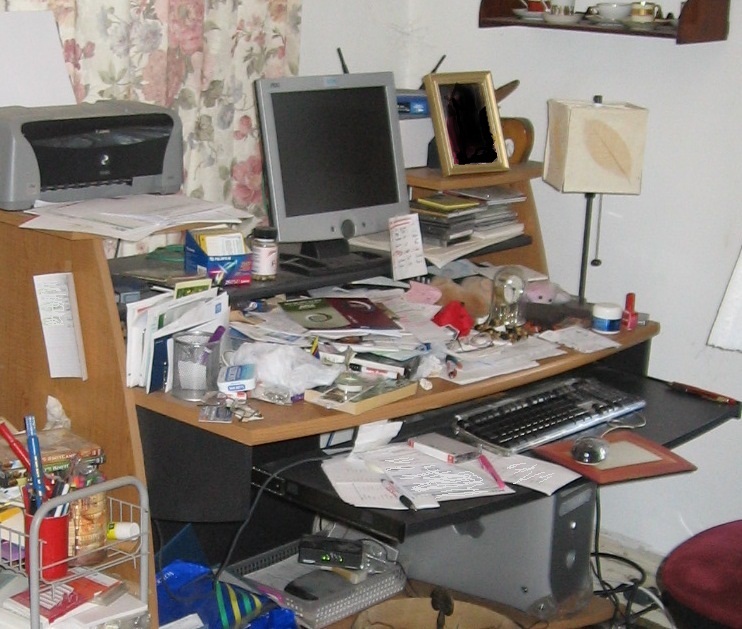
(Another I use to justify myself:  "If a cluttered desk is a sign of a cluttered mind, of what, then, is an empty desk a sign?" And yes, I know the guy in "The Big Bang Theory" television show quoted him as "messy desk", but he was wrong.)

So anyway, there we had it. One sentence, almost insultingly (at first) simplistically described a work I'd put half a year into, and made quite multi-layered and action-infused, if I do say so myself. It had covered the baseline of my plot in a way that at first glance made it look crap. But if I understand how to describe it in a sentence, and can also describe what I want the reader to feel in a sentence (which I won't reveal), I can have tremendous clarity of thought and purpose in writing the book. I can even have a way with words.

23 August, 2013

In the Thick of It


One of my less creative titles. Why? All of my creative energy is expended elsewhere!

That's right. Some of my regular readers will have noticed I've not been posting much lately. Sorry guys and gals. I hope my guest posters have held your interest. I know I liked what they did, and I'll take this opportunity to say another big "Thank you."

I've been punching my way through the final draft of Paint the Raven Black, and I've learned so much, my brain has been set to explode. Not literally. That would be gross. But figuratively, it would make the average Tarantino movie look like Winne the Pooh.

I've decided I'd better come back to internet life. I'll even start marketing on Pinterest and Google + and all that stuff again. Far more importantly, I'll start giving updates on my progress. As I've said, I'm learning a tonne along the way. This novel is the one I'm learning to write novels with, if you see what I mean. I've written a novel before. Everybody starts with some horrible, messy novel before really attacking the craft. Seriously, every writer I've ever met, everybody I met on the MA or MFA, everybody. Mine was called The Nameless One, and it was a good idea, but a terrible book. It will become a good book one day, but only thanks to my having learned how to accomplish that by writing Paint the Raven Black.

As this is a blog about writing, I'll let you know what I learn as I go! If it turns out I'm correct about any of it, we'll all have benefited! If not, I'll try again!

Here are a couple of practical things I've learned:

1) Eagerness is your enemy.

Impatience has been the bane of my career. And this close to the polished draft of a book, it's a 200 pound gremlin ready to jump on my shoulder. I've written before about being willing to plunge back into the draft when it's beneficial, rather than simply necessary. But there's another thing I've learned. I'm constantly tempted to sit and finish--to just blitz my way through page after page. It's important in those moments to take stock, and that's easier said than done. Go for a walk, pet your cat, do some push ups. Whatever. Just leave the smegging keyboard. I promise, you'll do better for it.

2) Eagerness is your smegging enemy, so manage your time.

Most professional artists only do around 4 hours per day, and I've discovered the reason. Energy wanes, even when motivation doesn't, and with less energy, I get sloppy. It's not a matter of careless prose or anything like that. It's a matter of impatient plotting, getting exhilarated with how much I can get done. Robert Silverberg, when he was my age, did 9-12, broke for lunch, then did 1-3.  I do 8-12, then 2-3. If I just turn off my internet explorer, don't check my emails or make any important phone calls for that short period, I get more done than 10 hours of everything at once. I also have more free time.

This is a very common time management method for artists and thinkers. Professional chess players do it, musicians do it, chefs do it, academics do it. The human brain can generally handle 4 hours on creative maximum per day. It's become something of a truism.

And here's the other side of that same coin: I have to make myself take time off. Take, for instance, right now. I'm at a point in the plot where it's very tempting to just re-use old material. What I've written previously is perfectly serviceable. It's actually pretty damn good, in my opinion, but I don't know exactly what I want to happen in the end. I know roughly. But at this point, in what Aristotle called the "denouement" (attainment into denouement--a way of looking at things I find helpful) I really need to know every detail, and I need to take stock of everything that's happened in the attainment. This is the part of the story in which nothing completely new should be introduced. New spins on old stuff is fine, but the reader is now seeking resolution, and the art of writing is all about reader psychology.

I might well use some of the old material. Smeg. I might well use all of it, word for word. But the point is I need a very clear image of why.

So, I kicked my impatience in the face. I felt like shooting from the hip, so I made myself sit down, calm down, and remember that only Texans do that. Once I find the target, I can aim properly.

The funny thing is, my fiance's mother is visiting. I want to show her how hard I work, but it's actually more productive for me to sit around playing Fallout 3 right now--a fact a 62 year old lady from Cumbria can't possibly understand. Yes, I'm feeling self-conscious. She can hear me typing this post right now, and she probably thinks I'm working on the novel. Thanks guys! Now where did they hide that "Luck Bobblehead"? (Fallout fans will understand.)


13 July, 2013

Guest Post by Josh Hoyt

Josh Hoyt's book seems like a handy idea to me. As you know by now, the theme on this blog has always been to make use of psychology to increase your story's impact. I've had a little e-back-and-forth with Josh and it seems to me that he knows his chops.


You can buy his book on Amazon HERE

He was kind enough to write a guest post for us, and I'm proud to have him.  Here it is:

As we create our characters and their stories it is important to understand how people in real life work and adjust to their surroundings so that our characters are more rounded and realistic. When our characters are more realistic, our readers will find themselves attached to those characters and will buy into their stories. Once a reader has bought in, we have them hooked. In order to understand how people behave and think we can look at psychological studies that have been conducted in the past. One of those studies that helps us understand why we as humans have odd reactions to certain things, such as being afraid of a stuffed animal, was conducted in the 1920's by John B. Watson.

Watson wanted to take the research conducted by Ivan Pavlov further and show that classical conditioning could be used to condition emotional responses (i.e. fear, anger, joy etc....) from a conditioned stimulus (i.e. stuffed animal, person with a beard, a car etc...) by tying that conditioned stimulus to an unconditioned stimulus (loud noise) that was already tied to an unconditioned response (fear). In order to do this Watson experimented with a child who they called, “Albert B.” The study today is more commonly known as the The Little Albert Experiment.

In the experiment Little Albert played with a white rat; Little Albert showed no fear of the white rat when he first held it. Later in the experiment Watson would hand the white rat to Little Albert and then make a loud noise which startled Little Albert. After doing this several times Albert became afraid of the white rat. The conditioned stimulus was the white rat and the conditioned response was fear. Watson showed through the experiment that a conditioned emotional response could be tied to a conditioned stimulus. Further, they proved that this conditioned response was generalized over to other conditioned stimulus. Little Albert not only showed fear of white rats but other similar white objects.

We see this happen to characters that we read about as well. For example, Frodo becomes conditioned to a stimulus, in this case a ring. In the beginning of the trilogy of Lord of The Rings, Frodo goes unnoticed by the world, feeling protected because of this anonymity (unconditioned stimulus) which comforts him (unconditioned response). When he enters the world and finds himself in trouble and being noticed by those around him, he puts the ring on (conditioned stimulus) and once again finds himself unnoticed (conditioned response). He continues to find comfort in putting the ring on which reinforces the conditioned response to the point that he can't let the ring go even if keeping it costs him everything.

Our characters not only have unconditioned responses to the situations they find themselves in but also conditioned responses that form through their story as they experience different stimuli that are paired with unconditioned responses. By developing these conditioned responses in our characters we show growth and change in our characters. They're no longer stagnate but alive and changing.

The easiest way to figure out our characters unconditioned responses and stimuli and their conditioned responses and stimuli is to make a simple chart.

Unconditioned Stimuli:

Unconditioned Response:

Conditioned Stimuli:

Conditioned Response:

Now just fill in the blanks. The responses will be the same. The stimuli are what changes. Keep in mind that the conditioned response is what the character learns and the unconditioned stimuli is what the character has already been exposed to.

For an example I'll take a character through this process.

Unconditioned Stimuli: home for Christmas Cookie smell.

Unconditioned Response: love, warmth, good feelings

Conditioned Stimuli: Young Woman baking cookies

Conditioned Response: love, warmth, good feelings

Now a short synopsis of how this could happen:

My sample character loves his mother immensely but lives a long way from her and can only afford to visit her once a year at Christmas time. During this time his mother always makes pumpkin cookies which have a very strong cinnamon spice smell that he can smell before he even opens the door. After visiting his family one Christmas his neighbor, a beautiful young woman, cooks some pumpkin cookies that he can smell through the thin walls. He instantly remembers his mother and the love he has for her and all the joys of Christmas. Later that day the young woman brings him a plate of the cookies and he instantly falls for her as he inhales the cinnamon spice pumpkin smell.

As you can see, after recognizing the different parts of classical conditioning I was able to make a believable synopsis of how the young couple fall in love. By understanding our characters and what drives them we can make realistic characters that our readers will love to get to know.


Josh Hoyt has a masters in Counseling from Northern Arizona University and is currently attending Utah State University for a Masters in School Psychology. He has worked with a range of patients, children and adults, helping sufferers of many issues including drug addictions, depression, anxiety and schizophrenia. He has been writing since 2009.

26 June, 2013

Re-writing is a Glorious Bastard


Something I said on twitter a little while back inspired this post. "Re-writing is exciting when you hit a scene that you don't have to change much. That excitement is your enemy."

As many of you know, I'm re-writing my novel. My agent's feedback was generally along the lines of, "this is decent, but it should be better." I like to think she means that I should be able to do better. That interpretation is more convenient for my ego.

Anyway, there's a rant-worthy lesson in this. With every word of this post my intention is to beat myself in the face with a truth I've known for many years, that I struggle everyday to remind myself of. I know for a fact I'm not the only writer with this problem.

I'll take my own work as an example. In this draft, I don't have to change as much as before, but I should. I'm improving the tautness of the plot, essentially. For instance, one of my characters seemed a bit of a doormat and I'm making her into something more frightening. She was supposed to be frightening for being a doormat, calling my main character forwards like a siren into something I won't reveal here. But such a call is hard for the reader to hear. A siren should be active, distracting. She can be subtle and coaxing, too, but the reader must feel her ability. It's my main character who should fail to understand, not the reader. That's where the dramatic tension come from. You'll understand if you read the book, and if you don't want to buy it from anywhere traditional, I'm sure I'll accept cash.

Things in my draft are changing. The aforementioned change is quite stark, but most are subtle. Not many scenes need a re-write. Not many chapters need re-thinking. But every tweak in a story should influence the entirety of it. The best stories are perfectly molded around their own convictions.

A simple example: if I decide a character has a little more backbone, I have to examine every single line of her dialogue. Most of what she says could remain the same for the purpose of plot momentum, but not plot tension. For empathy with her, and indeed the entire book, the method of her action must reflect her motivation, even where that change appears slight. Everything begs examination.

After re-working her, every character's response around her begs examination. In actuality, I have to examine every scene that has anything to do with her, which in a good book will be all of them, if only subtly, for the simple reason that she's a vital character. I've said before that a novel is like a symphony. A short story is like a rock song. The symphony might be more complex, but each element supports each element much the same.

None of this is stuff will I have to do to make my book readable, or even good, but it's all necessary to make a book great.  I love the idea of having an advance, starting my life as a professional author et cetera, but I must love the idea of making great art more.  I have to write what I would want to read, i.e. what I think deserves to exist.

I never said I could make a great book. I have no idea. But if I don't try, what the smeg am I making art for? If I'm satisfied, by nature, to produce only that which is necessary, to just balance things until they make sense, why not be an accountant? No, art isn't about perfection. Perfection is a word with no reality whatsoever except in arithmetic. Art is about trying our best. And it's exciting coming across a section of my book that I don't really have to change. The day I wrote that tweet (I hate that phrase) I could have gone through 15,000 words of my story if I'd wanted. Instead I did 1,000, about half of what I usually get through in a day. Excitement was my enemy, so I made myself examine everything twice as hard.

I know there comes a point where you're doing this:


(I had to work this awesome image in somewhere. I couldn't find the artist's name, sadly.)

There's a point where you're recreating yourself without any regard to your intended creation. That's the point where it's time to stop, send this book away, and write a different one. I've been trying to write this book for a year, but it's my first decent one, and I want to learn the skills that I'll go on to use later. More than that, though, I want all my books to reflect my best efforts.

09 June, 2013

Marvel Comics and Film Noir - What they taught me about writing.

J.E. Ryder.jpgJ.E. Ryder writes plot-based thrillers with strong characters. Her debut thriller, Blood Pool is available from Amazon. She lives in North Dorset, England where she is working on her next novel, a sweeping thriller that spans the European continent, a story of tragedy, vengeance and love.  In this post, she demonstrates how the love of stories can, and should, shape you into the writer you want to be.


I knew early what I didn’t want to read. Though I longed for adventure my mother bought me all the usual little girl comics/magazines containing stories about ballerinas in pink tutus, owning a pony, or cute puppies and donkeys. Even at such a tender age I didn’t care for them. I’d rather be out climbing trees.

One memorable day, I discovered that my brother’s reading was entirely different from mine, and much more exciting. All it took was a glance at his fabulous Marvel Comics and I was hooked. The 1960s story lines, (pre-computer and pre-digital) were perhaps simpler in outlook than those of today, yet their impact was dramatic. Back then I enjoyed them at face value - superhero good guy/gals battling superhero bad guy/gals.

Now, I can see I was taking subconscious writing lessons. Those superheroes had internal dramas, personal problems to overcome in order to vanquish the enemy. Each image on the page represented a moment of action, a micro-scene. Brief speech bubbles or explanatory tag lines conveyed the scene’s intent, the remainder to be fleshed out by the reader’s imagination. Enough tantalising plot information was dangled in front of us to make us turn the mental page and move on to the next image.

At the same time, another visual medium was adding to my writing knowledge. During winter weekends, when the weather was too dismal to go out, we had Sunday afternoon TV. In the late1960s and early ’70s, programme schedulers broadcast weekly reruns of 1940s and ’50s movies, all genres, romance, drama, comedy, cowboy and war. I loved the 1940s monochrome movies known as film noir - melodramas about cynical private eyes, corrupt cops, vicious gangsters and battle-weary soldiers returning from war.

Those tough leading men were more than matched by their female leads, strong women determined to succeed, dangerous femmes fatales able to convey sexual tension in a smouldering glance or commit cold-blooded murder. The scripts were spare and the dialogue crisp, often rapid-fire, coupled with fast-moving scenes that built to an explosive finale. It’s no surprise to me that fifteen of those 1940s movies received Oscar nominations for the screenwriting.

This post was prompted by a review for my novel, Blood Pool. The reviewer wrote, “Fabulous thriller…like watching a movie pan out.” I sat up when I read her words. She’d noticed what I hadn’t. The story does roll through my thoughts as if I were watching it flow across a screen. My fingers tap the keyboard and the action plays out, the dialogue crackles, the characters strut across the stage, their internal conflict and body language adding to the drama. I know what they’re thinking or feeling even when they’re out of sight, waiting in the wings for their next appearance. I’m like an all-powerful movie director. Fade in. Play the scene. Fade out.

The great film noir actor, Humphrey Bogart (1899-1957) is quoted as saying, “the only thing you owe the public is a good performance.” Sound advice. I must finish up here. I’m working on my next novel and I’ve had an idea. I must get the scene out of my head and onto the page before I forget. Step back everyone. Give the actors room to breathe. Are we ready? Lights. Camera. Action!


When Sam Shelley’s husband dies she becomes the owner of his boat yard and estates. The Shelley men have inherited the land for two hundred years. Locals want it to stay that way. They’re threatening to trace the rightful male heir.

Then an old friend, an eccentric inventor, disappears in violent circumstances. Sam will do anything for him: he’s been like a father to her while she grieved. The race is on to find him. The authorities want him for murder. Criminals want him and his latest invention, worth millions on the global market, for themselves.

Sam is determined to reach him first. Soon, she’s squeezed between murderous factions outside the boat yard and deadly rivalries within. No one is what they seem, especially those nearest to her…