27 September, 2013

Correspondence Tuition and Editorial Critique

I wish to offer my readers manuscript guidance and correspondence tuition.

My credentials include two postgraduate degrees in Creative Writing, a PGCE in Teaching and Learning in Higher Education, co-founder and editor of Ripple Magazine, Seminar Leader at Kingston University, and of course many years of selling short fiction all around the world.

I'm trained and qualified to teach Creative Writing. I was lucky enough to learn from the best, including Steve Erickson, Paul McAuley, Scott Bradfield, Rachel Cusk, Stephen Jones, Christopher Priest and many others. Upon request, atop your manuscript critique I'll point you in the right direction, having assessed your strengths and weaknesses, suggesting authors worthy of study and general areas of focus.

I charge:

£8 for up to 1000 words.

£12 for 1000-1500

£15 for 1500-2000

£20 for 2000-3000

£25 for 3000-4000

I am of course willing to round down . If, let's say, your manuscript is 1,050 words or something silly like that, I won't charge you an extra £4 for 50 words.

Prices for longer pieces can be negotiated. The longer it is, the less money you'll spend per word.

Send your manuscript as a .doc, .docx or .rtf file and I will smother it in red text, strikethroughs and brackets, and send it back to you mangled and ready for improvement. Along with craft advice, I will suggest markets to which I believe your work could sell.

If interested, please contact me at wm.luke.everest@gmail.com or use the comments section below and we'll swap email addresses. Feel free to contact me beforehand with further questions, but please do so via the comments section below. Please also feel free to leave feedback below!

I cannot guarantee your story will be ready for publication after my critique. I can guarantee that your work will improve, and most importantly, you'll receive direction in a long, often baffling and almost always lonely learning process.

For correspondence tuition, lessons will be set according to a student's level and needs. For instance, if you're having trouble generating ideas that you feel confident in, after a conversation to help me determine how/why you feel stuck and what kind of stuff you want to write, I'll offer writing assignments designed to help you break free of your slump and achieve your long term goals.

I'll recommend study materials which will include articles on the art of writing and books worthy of analysis, all specifically tailored to your needs. Reading assignments will be based on areas for improvement and general aspirations. A science fiction aspirant will receive different reading lists to a literary aspirant.

The initial consultation is free. Contact me if interested.

Beyond that, I charge £30 per lesson. This includes the price of a manuscript critique (up to 2,500 words) a one on one tutorial session via skype (30mins) about my critique, answering any questions you may have and going into further detail with general issues, and future guidance (or homework, as some unpleasantly label it) tailored to your needs.

For longer packages, I charge

£150 for six lessons (effectively giving you the sixth one free)

£200 for ten lessons

24 September, 2013

Exclamation Points at Home are a Sign of Poor Planning at Work!!!!!!!!!!!!!!!!!!!!!!!!!!!!!!!!!!


You'll notice many of my novel-related posts are riddled with exclamation marks. This is for good reason...! Partly, those are how I stay awake these days, and partly, those are just how I feel. (!)

Write an outline as you go! Seriously, do it! For the love of Gandalf!

If it were socially appropriate for me to walk around with a reminder note dangling before my face from a straw taped to the top of my head, it would say this.

When you take stock of your plot, you will benefit tremendously from having a scene by scene outline. And it will be a massive pain in the ass--if Donkey Kong were a baboon the pain could even spread to encompass his massive, extravagant buttocks--to go back over and read your entire book, writing a summary from start to finish. I, through not following my own advice, have now had to do this five times. I know it's good to read your book over and over, but it's demotivating to realise that's all you can do for a few days: read, summarise, read, summarise, find gun, summarise, read, aim, kill self.....

Seriously. It sucks. (!)

Other than the obvious, "What happens?", here's some stuff to make note of in each summary:

What has each character revealed about themselves? This goes for a particular look your POV character has noticed (he clicks his tongue when he's nervous, he likes hats, whatever) to a deep secret. Note everything. You'd be surprised how easy it is to forget, and find yourself carefully sculpting another description only to discover you've just wasted an hour.

Ditto for the setting, if that's relevant.

What has your character learned? In a way, the first two things fall into this category, but I mean this in terms of plot. If it's a character novel, how have they grown? If it's a crime mystery, what clues have they uncovered, and also how have they grown? Note everything, even if it seems irrelevant. Once you get to the denouement, it won't be.

Even more importantly (I'll touch on it now and write a post about it later) what does your character want?

Note anything, even if it's just a phrase, that you're going to refer back to. If you discover this later (as in, if you discover that you're going to refer back to something after having already done so unconsciously, or just deciding to after the fact) go back and change your outline. Do it right then! Otherwise you might forget! In a good book, you'll probably refer back a lot, and it's a pain big enough for Donkey Kong's ass, even if he were a baboon, to go back and find them from the huge mess of text.

As far as I can tell, that's about it. Note them in detail, though. My advice is to have two versions of your outline, printed and sitting on your desk. In one, have the details. In the other, just have a sentence or two describing the action at its most basic level. That simplistic version will be handy for jumping around the text. There's "document map" in MS Word, but sadly it's been programmed by small children and/or monkeys. It's horrible. Seriously. If the people who programmed it weren't innocent children and/or cute fuzzy monkeys, if they were adults who performed the atrocities deliberately and knowingly, then they should be sent to prison. Furthermore, having things in outline form on paper will mean you can look at it and your novel at once. Also, and better still, you'll see the shape of each chapter. It's very handy. (!)

16 September, 2013

"Character," Christopher Priest said to me


I had the honour of meeting Christopher Priest. He gave a talk/reading at my old university and Ruth (my fiance, whom I met on the MA) and I were invited to attend. In the Q and A session, I selfishly pestered him with far more questions than anyone else. Yes, call me a douche bag, but I was the douche bag who got the most out of the Q and A session, so there you go.

I told him I'd gotten stuck in my book. I'd pulled the trigger before I'd aimed the gun, and I was writing my way out of a black hole (all of this I've mentioned in the blog many times). I asked what a professional, Chris Nolan and Stephen Spielberg (who's expressed interest in The Separation) attracting author would do and/or focus on to get out of the mess.

"Character," he said to me, nodding and looking right into my eyes. Amazingly, that one word made perfect sense, and changed my perspective.

The book isn't about stuff happening. I was struggling so hard to make it all feel unified, I hadn't let myself sit back and take stock. Who is my character really? What does he want/need/feel? I had to know all this on the deepest level, because it's character that makes great fiction. Every scene should be about (not just infused with, but actually 100% about) my main character's emotional needs. The plot is a question of those needs. Otherwise there's no story.

Christopher Priest's one word lesson helped more with my book than anything I've come across.

I was reminded very strongly of something Scott Bradfield and Paul McAuley each said to me on separate occasions:  "The reader follows the character, not the story." It seems great craftsman are in agreement on that score.

04 September, 2013

Oversimplifying Under-simplifications


In an old post, "Spank Me", I mentioned getting hard-core (interpret that as you will) advice from my agent. Another interesting thing happened in a little back and forth we had afterwards. She asked me to describe the plot on simple terms. I did so in three or four paragraphs, seemingly little for an 80-100,000 page book. She questioned me in some depth and finally said, "So it's about a (thing happening) in a therapeutic hospital that you want perceived as an evil one."

"Curses!" I thought. What an oversimplification! Does that mean she hates the book because it's too smegging simple!? I've worked hard to lend that idea depth. I wrote back something along the lines of "Yes, essentially, but I want the reader to take my main character's side. I want to challenge their values, make them understand something very few people understand, and generally make the evil thing seem like a really meaningful, but also just plain cool, engaging thing." Blah, blah, blah. There was more than that, but that's the gist. Literally seconds after clicking the "send" button, I realised what Leslie was doing.

"If you can't explain a concept in simplistic terms, you don't truly understand the concept," as Albert Einstein said. I love Einstein quotes. He had a terrific clarity of thought and way with words.

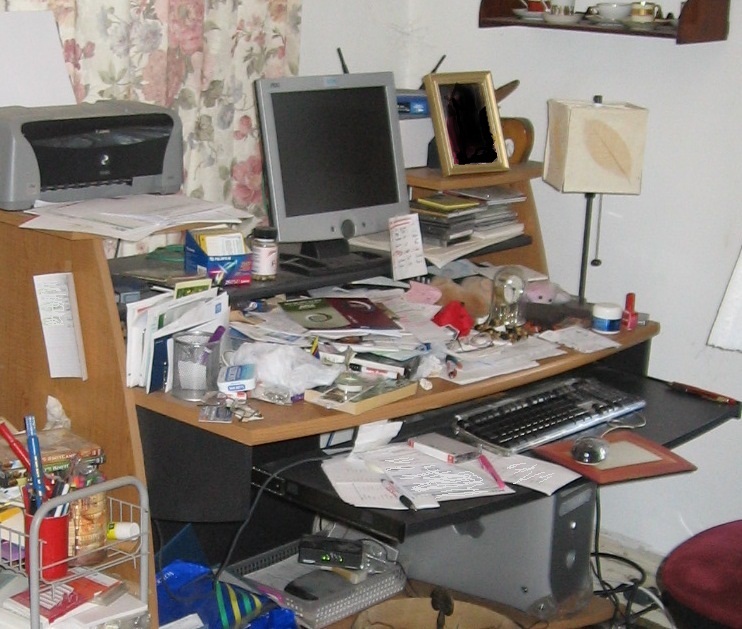
(Another I use to justify myself:  "If a cluttered desk is a sign of a cluttered mind, of what, then, is an empty desk a sign?" And yes, I know the guy in "The Big Bang Theory" television show quoted him as "messy desk", but he was wrong.)

So anyway, there we had it. One sentence, almost insultingly (at first) simplistically described a work I'd put half a year into, and made quite multi-layered and action-infused, if I do say so myself. It had covered the baseline of my plot in a way that at first glance made it look crap. But if I understand how to describe it in a sentence, and can also describe what I want the reader to feel in a sentence (which I won't reveal), I can have tremendous clarity of thought and purpose in writing the book. I can even have a way with words.

23 August, 2013

In the Thick of It


One of my less creative titles. Why? All of my creative energy is expended elsewhere!

That's right. Some of my regular readers will have noticed I've not been posting much lately. Sorry guys and gals. I hope my guest posters have held your interest. I know I liked what they did, and I'll take this opportunity to say another big "Thank you."

I've been punching my way through the final draft of Paint the Raven Black, and I've learned so much, my brain has been set to explode. Not literally. That would be gross. But figuratively, it would make the average Tarantino movie look like Winne the Pooh.

I've decided I'd better come back to internet life. I'll even start marketing on Pinterest and Google + and all that stuff again. Far more importantly, I'll start giving updates on my progress. As I've said, I'm learning a tonne along the way. This novel is the one I'm learning to write novels with, if you see what I mean. I've written a novel before. Everybody starts with some horrible, messy novel before really attacking the craft. Seriously, every writer I've ever met, everybody I met on the MA or MFA, everybody. Mine was called The Nameless One, and it was a good idea, but a terrible book. It will become a good book one day, but only thanks to my having learned how to accomplish that by writing Paint the Raven Black.

As this is a blog about writing, I'll let you know what I learn as I go! If it turns out I'm correct about any of it, we'll all have benefited! If not, I'll try again!

Here are a couple of practical things I've learned:

1) Eagerness is your enemy.

Impatience has been the bane of my career. And this close to the polished draft of a book, it's a 200 pound gremlin ready to jump on my shoulder. I've written before about being willing to plunge back into the draft when it's beneficial, rather than simply necessary. But there's another thing I've learned. I'm constantly tempted to sit and finish--to just blitz my way through page after page. It's important in those moments to take stock, and that's easier said than done. Go for a walk, pet your cat, do some push ups. Whatever. Just leave the smegging keyboard. I promise, you'll do better for it.

2) Eagerness is your smegging enemy, so manage your time.

Most professional artists only do around 4 hours per day, and I've discovered the reason. Energy wanes, even when motivation doesn't, and with less energy, I get sloppy. It's not a matter of careless prose or anything like that. It's a matter of impatient plotting, getting exhilarated with how much I can get done. Robert Silverberg, when he was my age, did 9-12, broke for lunch, then did 1-3.  I do 8-12, then 2-3. If I just turn off my internet explorer, don't check my emails or make any important phone calls for that short period, I get more done than 10 hours of everything at once. I also have more free time.

This is a very common time management method for artists and thinkers. Professional chess players do it, musicians do it, chefs do it, academics do it. The human brain can generally handle 4 hours on creative maximum per day. It's become something of a truism.

And here's the other side of that same coin: I have to make myself take time off. Take, for instance, right now. I'm at a point in the plot where it's very tempting to just re-use old material. What I've written previously is perfectly serviceable. It's actually pretty damn good, in my opinion, but I don't know exactly what I want to happen in the end. I know roughly. But at this point, in what Aristotle called the "denouement" (attainment into denouement--a way of looking at things I find helpful) I really need to know every detail, and I need to take stock of everything that's happened in the attainment. This is the part of the story in which nothing completely new should be introduced. New spins on old stuff is fine, but the reader is now seeking resolution, and the art of writing is all about reader psychology.

I might well use some of the old material. Smeg. I might well use all of it, word for word. But the point is I need a very clear image of why.

So, I kicked my impatience in the face. I felt like shooting from the hip, so I made myself sit down, calm down, and remember that only Texans do that. Once I find the target, I can aim properly.

The funny thing is, my fiance's mother is visiting. I want to show her how hard I work, but it's actually more productive for me to sit around playing Fallout 3 right now--a fact a 62 year old lady from Cumbria can't possibly understand. Yes, I'm feeling self-conscious. She can hear me typing this post right now, and she probably thinks I'm working on the novel. Thanks guys! Now where did they hide that "Luck Bobblehead"? (Fallout fans will understand.)


17 August, 2013

The Alliance of Independent Authors

Most of you will not be in England, let alone near Stratford upon Avon, but regardless of whether you attend the event, these guys have plenty of online appeal. Whether you want to self-publish or not, anything that helps you network, improves your marketing skills and helps you understand any side/element/method of the industry is a great thing. I'm proud that ALLi wants to advertise on my site, and I highly recommend them.
 
 
Take control of your (writing) life


Writers these days have so much choice. The traditional option of getting an agent and a publisher (if your work is good and you’re lucky) is not the only way anymore. There’s self-publishing.
 
Why choose this?
· More control. For example, over content and cover
· Your work is available to the reader faster (books travelling the traditional route can take as long as a year to be published)
· Depending on how you outsource the work, the costs you incur may be fixed, as opposed to a percentage of your earnings
 
Whether self-published or traditionally published your work should be good, i.e.:
· captivating story
· fascinating characters
· page-turning plot
· clarity of writing
 
The work also needs to:
· be very well edited (over and over)
· have hardly any typos (professionally proofread)
· have a first-class cover
 
With an agent and publisher, you have some help with the last three points, and also some initial help with the promotional effort. When you’re self-published, you’re on your own. Or are you? Enter, ALLi. http://allianceindependentauthors.org
 
ALLi is the Alliance of Independent Authors, an online network of hundreds of people in various countries across the world. Members are involved in self-publishing, either as authors or author service providers. There’s also student/associate membership. ALLi has a vibrant member community on social media, providing advice, feedback, support and information on all aspects of self-publishing. It’s also a great way to network with people. As well as platforms such as Facebook and Goodreads, there’s also an ALLi self-publishing blog, and the chance to promote your work online, as part of your member organisation. So far so good.
 
But sometimes it’s good to meet in person.
 
So ALLi in the UK (Midlands) is inviting all authors, published, self-published and seeking to be published to attend our first meeting on 14 September.


Why attend?
  • For writers at all stages including those who have or are considering self-publishing
  • An opportunity to meet fellow writers, network and share ideas
  • Discuss issues, tell others about your work and find out more about ALLi, the Alliance of Independent Authors, a rapidly growing organisation with hundreds of members on six continents
Where: Dirty Duck Pub (also known as The Black Swan), Waterside, Stratford-upon-Avon CV37 6BA (future venues may vary) https://www.oldenglishinns.co.uk/our-locations/the-dirty-duck-stratford-upon-avon
When: Saturday 14 September at 11 am
 
Location: the pub is very near the centre of town and just a few hundred yards from the RSC Theatre on Waterside
 
Attend the meeting and enjoy a visit to the lovely town of Stratford-upon-Avon, home of Shakespeare and Marie Corelli.
 
The meeting is FREE, and all writers are warmly invited, but please let us know if you’re going to attend.
 
Contact: allim@headweb.co.uk
Bren Littlewood
Ellie Stevenson

12 August, 2013

I Got Interviewed

My first serious author interview is up on Elizabeth Twist's great website. I'm not sure how big her audience is. I don't really care. She asked some tough questions that I was proud to answer. To all my fans, and people who just accidentally clicked the link to my site (in your face! I mean... welcome!) I hope you enjoy reading it as much as I enjoyed writing it.

It was a cool experience. I had to make many tough decisions about how much to reveal, not only artistically and intellectually, but personally too. I'm glad to have made the decisions now. In the public eye, you have to be very careful what you say, because your words are indelible. Any half-truth or over-statement or just plain thoughtlessness will haunt you. I remember China Mieville saying that in one of his interviews, and it stuck with me.

Thanks a million to you all. Before starting this blog, nobody wanted to interview me. I'm proud of every one of my readers, and I'd thank each of you in person if I could. I hope to do your appreciation justice with some good books one day. Until then, here's a good interview!

http://elizabethtwist.blogspot.ca/2013/08/interview-with-luke-everest.html

11 August, 2013

Why Write-a-thons are Awesome


Note: they're also bull.

Amazingly, this grand paradox actually expresses in itself why they're awesome.  Read on.

If you're a speculative fiction writer, you know about Clarion.  If not, I've turned the name into a handy link, as well as that link button, and this one.

Another note:  This post is posthumous (if my unconscious mind just created that pun, rest assured my conscious mind has told him off). I must apologise. My regular fans will have noticed that I haven't been blogging much for the past month. A lot of bad personal stuff that I won't tell you about has happened, but I've also just been writing really hard core. I'm always pretty hard core, but I desperately want to get a finished product to my agent by the end of this month, and it's going to be a rough ride. I wrote this post two months ago and forgot to hit the "post" button. Sorry. I'm on the ball again, I promise.

Anyway, in my time, I've been skeptical of Clarion for two reasons.

1)  A group of established writers selecting proteges based in part on the perceived quality of their ideas will create an inevitable bias towards established tropes. It seems reasonable that the ideas highly regarded by the establishment (thus the established writers) are, at any given point in history, inevitably already established.

I've come to think something else.  So long as established writers are actively seeking originality, this won't necessarily be the case.  Thus it will only sometimes be the case, which leaves it, in my opinion, in the category of valid concerns.

I have serious trouble trusting authority.  The more I've learned about art, life, academia and society the more I've become proud of that fact.  It isn't that I'll never trust an authority figure.  It's that my first instinct is, "Watch this person closely.  I must choose whether or not to trust them on the basis of their own virtues, not on their being an authority."

2)  You can't become a better writer in a couple of months (or however long it is). Now, in a sense, you become a better writer every day. And there will be the occasional leap in understanding, and it will take place in a small time frame, but they will be far apart. It takes years to learn the craft and years to find your own style and purpose within  the art.  It's ridiculous to think that after eight weeks (or however long it is) of study a person will go from un-publishable to professional.

What a good teacher can give you is a plethora of tools to carry forward into your own learning process. If any of you decide to study an MFA in Creative Writing (or MA or MSt--whatever) if your teacher says that by the end of the year you'll have a publishable novel, they're probably a bad teacher. It take a long, long time to become a writer.

Here's the good news.  Some of you might be worrying that you'll spend years of your life slaving over this amazing craft that you love.  You'll write a million words and five books that never sell and you'll read voraciously and just after your husband/wife leaves you and your bank balance runs dry and your roof caves in on your computer and you can't afford a new one of either, you'll still fail.  Do you know how many people that happens to, or has ever happened to?

NONE!!!!

No one will ever slave over the craft to fail at it!  Never in your life will you meet a person who has honestly given something the best they've got and failed to achieve at least some measure of success at it.  A person who wants to be UFC Champion might never make it, might never even fight in the octagon, but they'll sure as hell be a damn fine martial artist, able to teach it professionally, if they put in over four hours per day of solid training between the ages of 16 and 26.  Same with everything.  A person might never compete in the Olympics but they'll wind up a damn good swimmer, or whatever.

Every writing tutor worth their meat knows that the VAST majority of people they teach won't ever succeed in writing!  Why?  They're not going to keep at it!  Yet a shocking number of Clarion students do succeed. Why the smeg is that?


1)  They learn the atmosphere of creativity.  This is something you can get on an MFA, but you have to do it yourself.  On my MFA, a group of four people became fast friends, meeting twice per week to talk about creative writing and once per week to critique each other's work.  This was purely extracurricular, but it meant writing became our whole lives.  Two of those people have gone on retaining equal focus.  One of those is me, the other is my fiance.  We still edit each other's work.  One of those people now works as an editor at the Lagoon Group and one of them now works in advertising.  That's three out of four in the literary industry.

Nikole, Ruth and I are the only three people on the MFA to carry our writing aspirations into the future.  That's three out of twelve, and all three came from a group of people who made writing the chief characteristic of their SOCIAL lives.  That's what Clarion does.  Students work together.  They constantly think and talk about creative writing, and they make close friends (or nemeses, who can be equally helpful) to encourage them to keep trying their best well after the event.

2)  You also get this on an MFA, but only if your supervisor(s) like you.  I was fortunate enough for this to be the case with Scott and Paul.  Through being around real writers, we get a sense of how they work, who they are and how they approach not just the tasks of craft, but of life.  Through a human relationship we come to understand on an emotional level that authors are human beings.

3)  Clarion students will be inundated with the knowledge that will carry them forwards into their writing education, which will in vast part happen alone.  You might think this should be number one, but we're talking about Clarion here as distinct from other writing courses.  Clarion is a fast paced, pound you in the head kind of experience.  It's possible on an MFA to do the bare minimum intellectually and emotionally.  Even someone who gets a good grade can detach themselves most of the time, letting life into the foreground while you're trying to learn.  In acquiring these tools, you are trying to completely alter your creative perspective.  Again, unless you are a rare exception, you will not be able to use them right away.  But if you do your MFA right, you will never be the same after it.  That, too, is what Clarion does.  It shoves people into an atmosphere in which they can't avoid making the craft their entire life, having craft technique, creative and personal-life perspective crammed into their brains.  Even in a short space of time, after Clarion a writer will never be the same.

4)  This last inevitability must be mentioned.  People will bitch about this, and probably some readers will, in the first half of this paragraph, think that I'm bitching too.  This happens when you do an MA (or MFA or MSt) as well, but to a lesser degree.  You will have met a great deal of professional, successful, well connected authors.  What you further get at Clarion is a large clique of distinguished alumni, and a serious accolade.  These aren't bad things.  I don't care if you think they're unfair.  It's irrelevant.  If you bumped into Stephen King and he told you he liked "the cut of your gib" (or however he expresses himself) and wanted to help you into the industry, would you tell him "That's not fair!  Go to hell!"  If the answer is yes, you don't take your aspirations very seriously.  The fact is, people have to work their asses off to get into Clarion, and if they get a head start in their career as a result, which they most certainly do, good for them.  They've earned it.

So why are Write-a-thon-s great?  They get people encouraged by the existence of Clarion!  I've already established above that the SOCIAL atmosphere of education is by far the most important thing.  That's what's happening here.  If we all get excited about Clarion, share ideas and take interest in each other's work, we're actually doing the most important thing about going to Clarion without even being there.  So let's get excited.

Why are they bullshit?  Don't let anyone tell you how much, when or what you should write.  Find a system that works for you, that you can get excited about, and make the most of it.  Anyone who offers established rules about how to go about Write-a-thon-ing doesn't know a smegging thing about the creative process.  The important thing is just to get cracking and have fun.

Initially, when I'd written this post, I'd said this:  "If I were doing this right I'd offer excerpts of my work every couple of days. Well, that's not how my creative process works right now. Plotting a novel requires smeg-loads of thinking, and most of my work is done by pen on a sheet of paper and has arrows drawn all over it. Scanning and posting my rambling diagrams will not engage the interest of most people."

Now, back in the present, I can't post excerpts anyway, but my point still stands.  Perhaps next year I'll set aside the time to write short fiction and post as I go.

Regardless, whatever helps you, do it!  My purpose in any given a-thon is to encourage my readers to have fun and forge a productive social network.


30 July, 2013

Two Editors, a Gun and a Mental Disorder

***PROFANITY WARNING!  DO NOT READ IF YOU'RE A SISSY!***

I was in an argument with a Facebook acquaintance some time ago, and for some reason this has stuck in my mind. I have to share this with you. This is what inspired my post on Standard Manuscript Formatting.  This person, who if she reads this knows who she is, is an editor. She was adamant that writers should only use one space after periods, and that failure to do so was sheer blasphemy.

"Did your publishing house inform authors to use one space?" I said.

"No. Why should they? Fuck you!"

"Well, standard manuscript format says to use either, and most writers use two spaces."

A friend of hers who works at Random House, one of the biggest publishers in the world cut in with, "Any Random House editor would kill you if you used two spaces."

Excuse me? Most professional, best-selling, money-making, business-existence-assuring novelists use two spaces, and one of the biggest houses in the world wants to kill them instead of make money off them?

"That can't be true," I said. "I've met editors from Random House. They're business people. They were talking about the importance of discovering talent and turning it into money, and how the speculative fiction market is unpredictable these days." I remember because I asked one of them if that's because the most thriving market is young adult, and you aren't sure what those readers are going to grow into. I even asked if they keep a close eye on the video game market to know what gamers will expect of fiction later in life. They thought the first was an interesting question and hadn't considered the latter, so I got a pat on the back. I like pats on the back from publishers, which is why I remember.

So I imagined all these business people thinking more about spaces after periods than making money, and it didn't sound right. "I'm fortunate to know people who know people," I said. "I'm fairly certain when my agent pitches a manuscript she cares most about the content, and I'm pretty sure most publishers haven't attempted to kill her."

"Fuck you! My friend works at Random Fucking House!"

"The Random House guidelines don't specify one or two spaces," I said, after double-checking.

"Why should they have to? Fuck you!"

Imagine the business meeting to discuss a manuscript that's taken the interest of the Random House decision makers:

"I love this story, Harvey. We've got to publish it."

"Yeah, this will make a mint, Bill. Let's give the author a small advance, just enough to keep them happy, and see what comes of them. We'll buy their loyalty later if the project pans out."

"I think we should just invest big-time right now. New talent is impor... holy shit."

"What?"

"This manuscript...." Bill's hand starts to shake. "I... I can't read it!"

"Why not?"

"Take a look." Bill passes the paper to Harvey.

"What the hell? This has two spaces--two spaces!--after every period."

"Is that why it's illegible? Why could we read it before?"

Harvey punches the arm of his chair. "This must have gotten past the slush readers. I'm going on a firing spree after this meeting."

"An agent submitted this one," Bill says.

"...I'm going to kill this writer. Nobody submits two-space-after-period-having manuscripts to Random House. No one."

Bill strokes his chin. "What was that key command for find and replace?"

"What are you talking about?"

"You can hit Ctrl-F, or something, go to Find and Replace, then type in spaces somehow and it fixes stuff for you."

Harvey loads his shotgun and stares at Bill. One of his eyes twitches.

Bill raises his palms. "Never mind! It was just something I heard one of the youngster slush readers telling me about!"

"Let's go kill that youngster, then kill this author." Harvey looks out the window for a long moment. "Did we remember to put up the new guidelines on the website, informing authors of our pathological hatred of multiple spaces on paper?"

"You want to ask that after getting your shotgun out? You're getting soft, Harvey. That's worse than my Ctrl-F comment. Let's swing by my office on the way to kill that slush reader. I have a magnum under my desk."

"Cool."

They leave together. A shooting spree ensues.

Here's the real kicker: could you read that story? I used two spaces after my sentences--periods, exclamation points, question marks, you name it! Did you even notice? Apparently if you were an editor at Random House, you couldn't have read it. You'd think such a disability wouldn't get you a job in publishing, but actually, when you really think about it, that's probably why they all had to get jobs at the same publisher. Either that or Kelly and her friend are completely full of shit. Which do you think is the case?

20 July, 2013

Grounded, by Jayne-Marie Barker

Another great guest-post by Jayne-Marie Barker. This one's on how to talk and act like a professional. I've found this kind of thing very important lately, and this is a good lesson. The farther you go, the more you'll need your ABCs (Always Be Cool).


'I didn't know you were a bestselling author in the making,' someone said to me today, sheer surprise wrinkling their face. 

Initially it would be easy to be mildly irrated by the shock, as if it were beyond your abilities to string together two words. As the suprise of those in your 'ordinary world' begins to break, you become accustomed to the reactions of others and perhaps acknowledge that it was a tad unfair to be so emotional when they voiced their surprise. People are consistently amazed to realise that someone they know has done something 'as difficult' (their words, not mine) as to have their book published. If you're a new author you'll probably be pleased to learn that the reaction of others, and your own, does mellow over time. The more we get used to something, anything in life, the easier we tend to manage and the smoother our self control at this point becomes. When you think about it, people are normally trying to be nice so it's only fair to give them the benefit of the doubt. However, then the really tricky bit kicks in...

It would be very easy to allow your head to swim up to the clouds and announce boldly that you are the best selling author of all time, even if this isn't quite true - yet! Perhaps the initial shyness has dilluted now that you're more used to the conversation with the newly discovered reader, but modesty should remain for all good British folk! It's part of our culture and whilst we tend to build in confidence we are a modest nation by default.

The tricky part of 'realization cycle' is to know when to advertise and talk freely and when to deploy the natural look of 'well of course, but hey, it's nothing. Thanks for noticing,' with a confident smile. There's a time and a place for advertisement and PR and for boasting one's own career with friendly chit chat. Book events and conventions are the places for these. You can go a little way along the path of 'here's the address of my website' conversation but if it's a casual enquiry born out of surprise , it pays not to overdo it. I did warn you, it's tricky, but the only golden rule I can work by myself is; 'just be yourself, always smile and be pleasant. Never be pushy.' We hate pushy people in the UK. Think about the car salesman who 'was lovely, never tried to push me into it,' and how often that person won the sale. The one who 'was all over me the minute I walked in the door,' will earn far less commission in life.

So - give it your best sweet smile and pray the enquiry is converted into a sale at some point down the line - but never push your luck! In short, keep your feet firmed on the ground, your head out of the clouds, and your eyes open to the world around you. We have two ears and one mouth... not a bad rule to remember. Good luck!

Jayne is a regular contributor to Everest by Fog. If you like mystery novels, give her website a gander. You won't regret it. Check out her books here and on Amazon. They've gotten great reviews. Or if you like using companies that pay tax and all that left-wing hippy crap, you can use The Book Depository instead of Amazon.

13 July, 2013

Guest Post by Josh Hoyt

Josh Hoyt's book seems like a handy idea to me. As you know by now, the theme on this blog has always been to make use of psychology to increase your story's impact. I've had a little e-back-and-forth with Josh and it seems to me that he knows his chops.


You can buy his book on Amazon HERE

He was kind enough to write a guest post for us, and I'm proud to have him.  Here it is:

As we create our characters and their stories it is important to understand how people in real life work and adjust to their surroundings so that our characters are more rounded and realistic. When our characters are more realistic, our readers will find themselves attached to those characters and will buy into their stories. Once a reader has bought in, we have them hooked. In order to understand how people behave and think we can look at psychological studies that have been conducted in the past. One of those studies that helps us understand why we as humans have odd reactions to certain things, such as being afraid of a stuffed animal, was conducted in the 1920's by John B. Watson.

Watson wanted to take the research conducted by Ivan Pavlov further and show that classical conditioning could be used to condition emotional responses (i.e. fear, anger, joy etc....) from a conditioned stimulus (i.e. stuffed animal, person with a beard, a car etc...) by tying that conditioned stimulus to an unconditioned stimulus (loud noise) that was already tied to an unconditioned response (fear). In order to do this Watson experimented with a child who they called, “Albert B.” The study today is more commonly known as the The Little Albert Experiment.

In the experiment Little Albert played with a white rat; Little Albert showed no fear of the white rat when he first held it. Later in the experiment Watson would hand the white rat to Little Albert and then make a loud noise which startled Little Albert. After doing this several times Albert became afraid of the white rat. The conditioned stimulus was the white rat and the conditioned response was fear. Watson showed through the experiment that a conditioned emotional response could be tied to a conditioned stimulus. Further, they proved that this conditioned response was generalized over to other conditioned stimulus. Little Albert not only showed fear of white rats but other similar white objects.

We see this happen to characters that we read about as well. For example, Frodo becomes conditioned to a stimulus, in this case a ring. In the beginning of the trilogy of Lord of The Rings, Frodo goes unnoticed by the world, feeling protected because of this anonymity (unconditioned stimulus) which comforts him (unconditioned response). When he enters the world and finds himself in trouble and being noticed by those around him, he puts the ring on (conditioned stimulus) and once again finds himself unnoticed (conditioned response). He continues to find comfort in putting the ring on which reinforces the conditioned response to the point that he can't let the ring go even if keeping it costs him everything.

Our characters not only have unconditioned responses to the situations they find themselves in but also conditioned responses that form through their story as they experience different stimuli that are paired with unconditioned responses. By developing these conditioned responses in our characters we show growth and change in our characters. They're no longer stagnate but alive and changing.

The easiest way to figure out our characters unconditioned responses and stimuli and their conditioned responses and stimuli is to make a simple chart.

Unconditioned Stimuli:

Unconditioned Response:

Conditioned Stimuli:

Conditioned Response:

Now just fill in the blanks. The responses will be the same. The stimuli are what changes. Keep in mind that the conditioned response is what the character learns and the unconditioned stimuli is what the character has already been exposed to.

For an example I'll take a character through this process.

Unconditioned Stimuli: home for Christmas Cookie smell.

Unconditioned Response: love, warmth, good feelings

Conditioned Stimuli: Young Woman baking cookies

Conditioned Response: love, warmth, good feelings

Now a short synopsis of how this could happen:

My sample character loves his mother immensely but lives a long way from her and can only afford to visit her once a year at Christmas time. During this time his mother always makes pumpkin cookies which have a very strong cinnamon spice smell that he can smell before he even opens the door. After visiting his family one Christmas his neighbor, a beautiful young woman, cooks some pumpkin cookies that he can smell through the thin walls. He instantly remembers his mother and the love he has for her and all the joys of Christmas. Later that day the young woman brings him a plate of the cookies and he instantly falls for her as he inhales the cinnamon spice pumpkin smell.

As you can see, after recognizing the different parts of classical conditioning I was able to make a believable synopsis of how the young couple fall in love. By understanding our characters and what drives them we can make realistic characters that our readers will love to get to know.


Josh Hoyt has a masters in Counseling from Northern Arizona University and is currently attending Utah State University for a Masters in School Psychology. He has worked with a range of patients, children and adults, helping sufferers of many issues including drug addictions, depression, anxiety and schizophrenia. He has been writing since 2009.

06 July, 2013

Let's have some will. Shall we?


"I shall be a writer," said the lazy posh git.


Will and shall are often confused, but it breaks down like this:

Things that shall happen are going to happen. It is outside anyone's control. It simply shall occur.

Things that will happen are things that one will affect (in the sense of the word, "to act upon").

So saying you"will" become a writer means you're striving for it. Saying you "shall" means it's happening without any work. Posh gits used it in olden times to sound composed and indifferent ("nonchalant", if you like French) not because it was just a fancier word. They used it, in essence, because they were gits.

But what separates the people whose wills become reality?


See the difference? No, not just the handsomeness, but the difference in the metaphors.

The Ancient Greek word "Arete" is commonly poorly translated into English as "excellence", but Arete wasn't seen as something to become, or to have others gift you with the perception of. It isn't something to do or to wait for. Arete has much more of a Fight Club ideal behind it: to achieve Arete is to let go of all things holding you back, because Arete is something to BE.

I could get into the sociology of the Ancient Greeks here and use fancy words like "eschatological", but let's suffice to say that the Greeks didn't see time as linear, with beginning and end. Their conceptions were much more focused on the present and on individualism. Life had no purpose except in and of itself. They had mythology, but their gods were largely metaphorical (to break another common misconception). To say Achilles was blessed by Ares was to say he had superhuman skill with the blade, not to say that some sword-slinging sky-man flicked him on the ear when he was a baby and told him he was going to kick ass. Their conception of what destiny meant was very different from ours. They did not see it with finality. They saw not inevitability, but potential. They did not think in eschatological terms.

I think most modern people agree that we don't have destinies. But in the Ancient Greek sense, we do. Everyone does. I bloody well do. There's a goal I make every possible effort to achieve. If I fail, it's going to be because I'm not good enough. Simple. It won't be because I'm lazy.

So what's your destiny, in the Greek sense? If you're on this blog, I'd imagine your destiny is not to play solitaire, watch television or surf the internet. Not that I'm saying you should leave. I don't want you to leave. But if you want to be writing instead of reading this, then I say good for you.

Every second you waste letting yourself think you'd be better off after a good rest, watching television, talking to yourself in the mirror or shooting kittens with water pistols is another moment that you are closer to death. Do you really just want to be another "normal" person?  Then you don't want to be an artist.  Artists are weirdos. If you really do want to be an artist you need to not have, but give yourself Arete.

Arete doesn't mean "self-creation" anymore than it means "self destruction". It's something to be. It means waking up every day and being the best father, mother, son, boyfriend, girlfriend, husband, wife, daughter, friend, mentor, cat owner and writer and whatever else that you care to be, every day.

26 June, 2013

Re-writing is a Glorious Bastard


Something I said on twitter a little while back inspired this post. "Re-writing is exciting when you hit a scene that you don't have to change much. That excitement is your enemy."

As many of you know, I'm re-writing my novel. My agent's feedback was generally along the lines of, "this is decent, but it should be better." I like to think she means that I should be able to do better. That interpretation is more convenient for my ego.

Anyway, there's a rant-worthy lesson in this. With every word of this post my intention is to beat myself in the face with a truth I've known for many years, that I struggle everyday to remind myself of. I know for a fact I'm not the only writer with this problem.

I'll take my own work as an example. In this draft, I don't have to change as much as before, but I should. I'm improving the tautness of the plot, essentially. For instance, one of my characters seemed a bit of a doormat and I'm making her into something more frightening. She was supposed to be frightening for being a doormat, calling my main character forwards like a siren into something I won't reveal here. But such a call is hard for the reader to hear. A siren should be active, distracting. She can be subtle and coaxing, too, but the reader must feel her ability. It's my main character who should fail to understand, not the reader. That's where the dramatic tension come from. You'll understand if you read the book, and if you don't want to buy it from anywhere traditional, I'm sure I'll accept cash.

Things in my draft are changing. The aforementioned change is quite stark, but most are subtle. Not many scenes need a re-write. Not many chapters need re-thinking. But every tweak in a story should influence the entirety of it. The best stories are perfectly molded around their own convictions.

A simple example: if I decide a character has a little more backbone, I have to examine every single line of her dialogue. Most of what she says could remain the same for the purpose of plot momentum, but not plot tension. For empathy with her, and indeed the entire book, the method of her action must reflect her motivation, even where that change appears slight. Everything begs examination.

After re-working her, every character's response around her begs examination. In actuality, I have to examine every scene that has anything to do with her, which in a good book will be all of them, if only subtly, for the simple reason that she's a vital character. I've said before that a novel is like a symphony. A short story is like a rock song. The symphony might be more complex, but each element supports each element much the same.

None of this is stuff will I have to do to make my book readable, or even good, but it's all necessary to make a book great.  I love the idea of having an advance, starting my life as a professional author et cetera, but I must love the idea of making great art more.  I have to write what I would want to read, i.e. what I think deserves to exist.

I never said I could make a great book. I have no idea. But if I don't try, what the smeg am I making art for? If I'm satisfied, by nature, to produce only that which is necessary, to just balance things until they make sense, why not be an accountant? No, art isn't about perfection. Perfection is a word with no reality whatsoever except in arithmetic. Art is about trying our best. And it's exciting coming across a section of my book that I don't really have to change. The day I wrote that tweet (I hate that phrase) I could have gone through 15,000 words of my story if I'd wanted. Instead I did 1,000, about half of what I usually get through in a day. Excitement was my enemy, so I made myself examine everything twice as hard.

I know there comes a point where you're doing this:


(I had to work this awesome image in somewhere. I couldn't find the artist's name, sadly.)

There's a point where you're recreating yourself without any regard to your intended creation. That's the point where it's time to stop, send this book away, and write a different one. I've been trying to write this book for a year, but it's my first decent one, and I want to learn the skills that I'll go on to use later. More than that, though, I want all my books to reflect my best efforts.

19 June, 2013

Standard Manuscript Format Doesn't Even Require Linguistic Evolution

Some writers will start out like this, looking all uncertain and unprofessional, poking the typewriter with a single finger, naked but socially acceptable thanks to a covering of thick fur...

Anyway, what you need is knowledge of how to submit your story to a publisher, magazine editor or literary agent.

Standard manuscript format (SMF) exists for everyone's benefit. It's simple, straightforward and known by every professional in the industry.

But our story does not end with the universal, because neither do submission guidelines. A minority of editors ask for their own specific pet peeves to be satiated, often because they find a particular format easier to read on screen, and sometimes simply in some diva-like bid for satisfaction of a power fetish. But we don't want to express annoyance with these people. We want them to fall in love with us and our work.

What I outline below is STANDARD practise. That means two things:

1) Always read the specific guidelines. If nothing else, you'll get some sense of the magazine, and you want to know if editors have their own specifications.

2) If they don't specify, send them SMF. If they don't like it, screw them.

I have met psychotic diva editors who not only have their own pet peeves, but will not inform writers of them. Don't worry about them. Everyone who's anyone agrees that these idiots don't deserve to exist. Interestingly, all the diva editors I know wanted to be authors back before they gave up. It's an issue of grudges.  If any of my relevant acquaintances are reading this, they know who I'm talking about. What's the emoticon for a middle finger?  oIoo  That will do.

SMF is simple.

12 point font, double spaced, usually Courier New or something else that's mono-spaced (meaning all letters take up the same amount of space) making it easier to detect spelling mistakes. Some like Times New Roman, which isn't mono-spaced. Some like Ariel. Some hate one or the other. Reading all day gives a person very strong (one might say irrationally so) preferences. I'm not certain as to whether the particular mental disorder has been named. I hereby copyright OCFD (Obsessive Compulsive Font Dictator). The nice part is, good OCFD sufferers acknowledge the need to tell you. They understand that they have a problem and they only want to be treated with respect.

Do read the guidelines. I know a guy who hates Courier New font. It fills him with rage. He doesn't know why. But he's a good chap and he's professional enough to tell people on his submissions page. If you submit in Courier, he is not only filled with irrational rage, but he knows the only thing you know about his magazine is the email address.

Back to SMF:

Do not put a double margin between paragraphs.

Indent the first line of all paragraphs in the usual manner. (1.25 is what Microsoft Word does automatically, so that's fine. Other programs do 1.27. Nobody will notice.)

In the top left of Page One, do not indent. Put your real name, address, email, phone number if you like. In the top right put your word count. Often magazines like you to state underneath that whether it's a short story, novelette or novella. Again, they read fast and churn through the slush pile quickly. They want to know what they're getting into.

Do not embellish your title in any way whatsoever. Leave it as plain font, the same size as everything else.


In the top of each page APART FROM THE FIRST should be:

Smith / Town Placeville / [page number]

Note: last name, SHORTENED title (if it's a long one), page number starting with page 2.

I use two spaces after colons and periods. Some writers don't. Some editors hate two spaces. Some hate one space. If they have a strong preference they should tell you or they can go to hell. You've noticed the theme behind this post now, I'm sure. To be clear, I'm not just a ranting writer. I'm stating the opinion of every professional, good, hard-working person in the industry. It's the editor's job to tell you. That is, tell you everything beyond the assumption that you'll know about SMF.

Note how "The Ice Man" did this at the end of his scene:

#

blank space
hash
blank space

Blam!  New Scene!

At the end of the story, make it clear. Write

END

or some such thing. No big deal. Just signify.

There. Simple. This'll not only make you look professional, but it'll make your work not be annoying. Editors are used to this format. They expect it, unless they notify you otherwise. If OCFD sufferers or editors with any other strange compulsion fail to tell you, use SMF secure in the knowledge that they're the ones being unprofessional. You'll have your pro-groove writer clothes on, so to speak, and you'll look more like this:


Any further questions, check out William Shunn's comprehensive article.

Happy (e)mailing.

09 June, 2013

Marvel Comics and Film Noir - What they taught me about writing.

J.E. Ryder.jpgJ.E. Ryder writes plot-based thrillers with strong characters. Her debut thriller, Blood Pool is available from Amazon. She lives in North Dorset, England where she is working on her next novel, a sweeping thriller that spans the European continent, a story of tragedy, vengeance and love.  In this post, she demonstrates how the love of stories can, and should, shape you into the writer you want to be.


I knew early what I didn’t want to read. Though I longed for adventure my mother bought me all the usual little girl comics/magazines containing stories about ballerinas in pink tutus, owning a pony, or cute puppies and donkeys. Even at such a tender age I didn’t care for them. I’d rather be out climbing trees.

One memorable day, I discovered that my brother’s reading was entirely different from mine, and much more exciting. All it took was a glance at his fabulous Marvel Comics and I was hooked. The 1960s story lines, (pre-computer and pre-digital) were perhaps simpler in outlook than those of today, yet their impact was dramatic. Back then I enjoyed them at face value - superhero good guy/gals battling superhero bad guy/gals.

Now, I can see I was taking subconscious writing lessons. Those superheroes had internal dramas, personal problems to overcome in order to vanquish the enemy. Each image on the page represented a moment of action, a micro-scene. Brief speech bubbles or explanatory tag lines conveyed the scene’s intent, the remainder to be fleshed out by the reader’s imagination. Enough tantalising plot information was dangled in front of us to make us turn the mental page and move on to the next image.

At the same time, another visual medium was adding to my writing knowledge. During winter weekends, when the weather was too dismal to go out, we had Sunday afternoon TV. In the late1960s and early ’70s, programme schedulers broadcast weekly reruns of 1940s and ’50s movies, all genres, romance, drama, comedy, cowboy and war. I loved the 1940s monochrome movies known as film noir - melodramas about cynical private eyes, corrupt cops, vicious gangsters and battle-weary soldiers returning from war.

Those tough leading men were more than matched by their female leads, strong women determined to succeed, dangerous femmes fatales able to convey sexual tension in a smouldering glance or commit cold-blooded murder. The scripts were spare and the dialogue crisp, often rapid-fire, coupled with fast-moving scenes that built to an explosive finale. It’s no surprise to me that fifteen of those 1940s movies received Oscar nominations for the screenwriting.

This post was prompted by a review for my novel, Blood Pool. The reviewer wrote, “Fabulous thriller…like watching a movie pan out.” I sat up when I read her words. She’d noticed what I hadn’t. The story does roll through my thoughts as if I were watching it flow across a screen. My fingers tap the keyboard and the action plays out, the dialogue crackles, the characters strut across the stage, their internal conflict and body language adding to the drama. I know what they’re thinking or feeling even when they’re out of sight, waiting in the wings for their next appearance. I’m like an all-powerful movie director. Fade in. Play the scene. Fade out.

The great film noir actor, Humphrey Bogart (1899-1957) is quoted as saying, “the only thing you owe the public is a good performance.” Sound advice. I must finish up here. I’m working on my next novel and I’ve had an idea. I must get the scene out of my head and onto the page before I forget. Step back everyone. Give the actors room to breathe. Are we ready? Lights. Camera. Action!


When Sam Shelley’s husband dies she becomes the owner of his boat yard and estates. The Shelley men have inherited the land for two hundred years. Locals want it to stay that way. They’re threatening to trace the rightful male heir.

Then an old friend, an eccentric inventor, disappears in violent circumstances. Sam will do anything for him: he’s been like a father to her while she grieved. The race is on to find him. The authorities want him for murder. Criminals want him and his latest invention, worth millions on the global market, for themselves.

Sam is determined to reach him first. Soon, she’s squeezed between murderous factions outside the boat yard and deadly rivalries within. No one is what they seem, especially those nearest to her…

03 June, 2013

Stephen King Gives a Talk at UMASS


I found this on Youtube today and thought I'd better share it with my fellow writers. If you aren't interested in watching Stephen King answer questions about the craft of writing, post your message in the comments section and I will help you find a psychologist.

This is what I do at lunch. I search the internet for online lectures and watch them while I chew. To be honest, most days it's a chess lecture, but yesterday I pretended I was a grown-up and did something pertinent to my work.

Enjoy!

I'll add a brief personal note. What Stephen King says about plotting is exactly what made me think I shouldn't do it. I had a notion that the greatest literary minds don't have to plot. If there's one thing I love about King's book, On Writing, it's that it's written as a memoir. It's his experience. I like to believe his implication is that you'll have your own experiences. I've recently discovered that I'm better off plotting, at least for now. Or, at least, I recently admitted it to myself. So what? Tolkien did it. So did Robert E. Howard, Alfred Bester, Iain Banks (and still does) H.G. Wells, Ray Bradbury, George Orwell... you get the idea.

I'm giving a word of warning to my younger self here, and anyone who suffers from the same malady. Just because your heroes do things one way doesn't mean that you have to. Every artist has to find their own method. It's just part of working with your own imagination, so be honest with yourself, young Luke! If you get this message back in time four years ago, you'll be a better writer by the time you're my age, and unless Quantum Mechanics theory is correct then I'll be...

I don't feel any different. Either Quantum Mechanics theory is correct, or my time travel experiment didn't work. Either way, I hope you enjoy the video. Maybe I'll notice a difference when I start writing fiction again. I'm going to click "Publish" now and get back to my word processor.


Thanks for the lessons Mr King. You are a ga-zillion kinds of awesome. One day I plan to shake your hand and get you to sign my book. (The likelihood of him reading this is minuscule, but whatever.)